
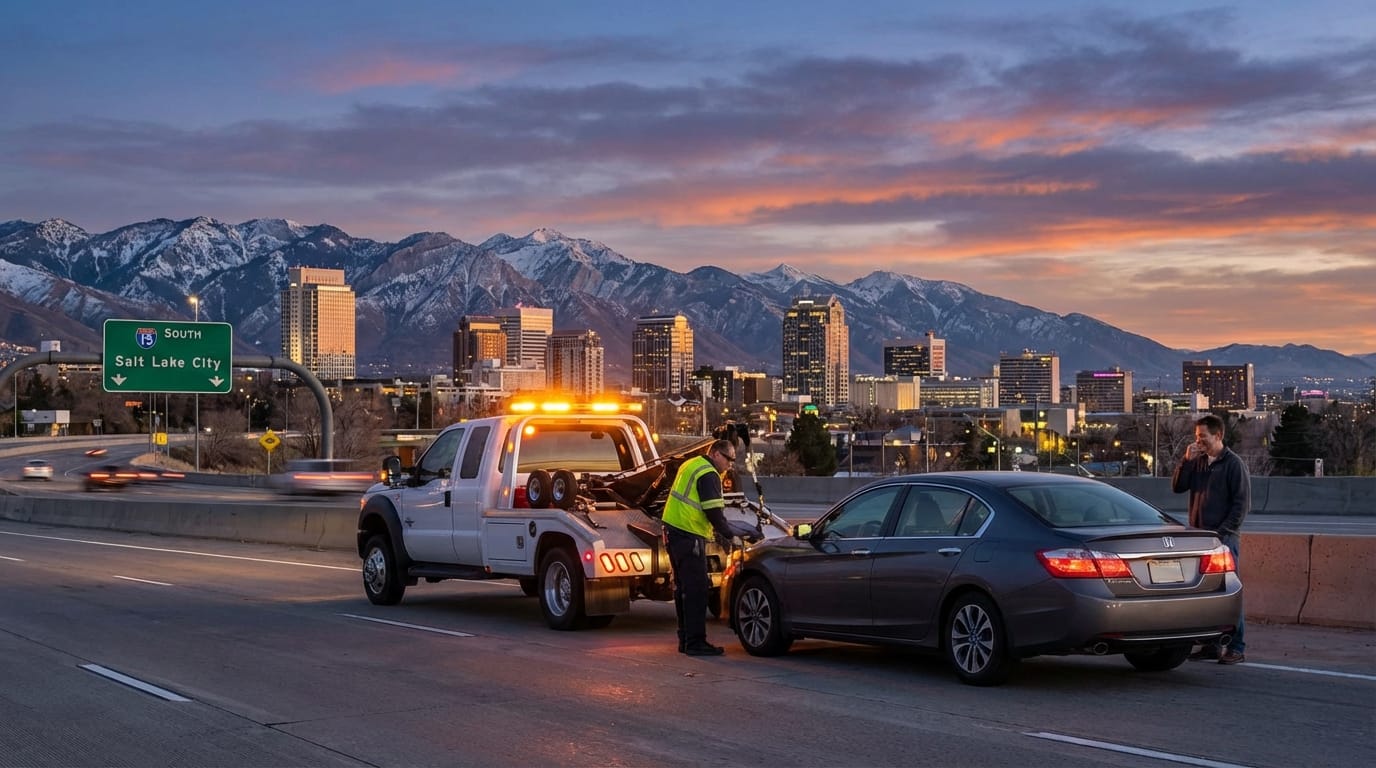
In the freezing grip of a Salt Lake City winter, the difference between a minor inconvenience and a life-threatening situation is often measured in minutes. Emergency towing is not just about moving a vehicle; it is a rapid-response safety intervention designed to extract you from dangerous environments like I-15 shoulders or icy Parleys Canyon before tragedy strikes. As we enter the peak of the 2025-2026 winter season, understanding how to access immediate professional help is your first line of defense against Utah’s unpredictable roads.
Key Concept & Definition: What Qualifies as Emergency Towing?
Most drivers conflate “roadside assistance” with “emergency towing,” but in the high-stakes environment of Salt Lake County, the distinction is critical for your safety.
Standard Towing is a scheduled service for a vehicle that is disabled but safe—for example, a car that won’t start in your driveway or a flat tire in a secure parking lot.
Emergency Towing, by contrast, is a priority service reserved for situations where the vehicle or its passengers are in immediate peril. This includes:
- Vehicles blocking active traffic lanes on high-speed arteries like I-215 or I-80.
- Breakdowns during severe weather events where sub-zero temperatures pose hypothermia risks.
- Cars stranded in blind spots, such as around curves in Little Cottonwood Canyon.
- Situations involving collisions where airbags have deployed or fluids are leaking.
In these scenarios, a standard 60-minute ETA is unacceptable; emergency dispatch protocols prioritize these calls to minimize the window of vulnerability.
Deep Dive into Strategy & Data: The SLC Danger Factors
Salt Lake City presents a unique “perfect storm” for drivers: high-speed interstate convergence, dramatic elevation changes, and the notorious “Great Salt Lake Effect” snow. The data from recent years paints a sobering picture of why rapid removal from the roadside is non-negotiable.
- Fatality Trends: Preliminary data indicates that 281 lives were lost on Utah roads in 2024, a statistic that underscores the lethal potential of lingering on the highway [1].
- Secondary Accidents: A significant percentage of winter accidents are “secondary collisions”—crashes caused by other drivers hitting a previously disabled vehicle.
- The “Move Over” Gap: Despite Utah’s strict “Move Over” law (Code 41-6a-904), many drivers fail to yield to stationary vehicles, increasing the risk for anyone standing on the shoulder [2].
- Winter Volume: Nationally, winter weather contributes to over 400,000 vehicular accidents annually, a burden heavily felt in Utah’s mountain corridors [3].
Breakdown Urgency Matrix
Understanding the severity of your situation helps you communicate effectively with dispatchers.
| Scenario | Risk Level | Recommended Action | Towing Priority |
|---|---|---|---|
| Stalled in Center Lane (I-15) | Critical | Stay buckled, call 911, then Towing | Immediate Dispatch |
| Slide-off in Canyon (Night) | High | Stay inside vehicle, keep exhaust clear | Urgent Priority |
| Flat Tire on Wide Shoulder | Moderate | Exit vehicle from non-traffic side | Standard Response |
| Won’t Start in Parking Lot | Low | Wait in nearby building | Scheduled Service |
Actionable Steps & Methodology: Surviving the Wait
When your engine fails on a snowy Tuesday night, panic is your enemy. Follow this precise methodology to ensure your safety while professional towing services are en route.
- Immediate Visibility: Engage your hazard lights immediately. If you have emergency flares or triangles, deploy them only if you can do so without stepping into traffic.
- The “Stay Put” Rule: Unless your vehicle is on fire or in the direct path of a sliding semi-truck, stay inside with your seatbelt on. Pedestrians on the highway are invisible to drivers battling snow blindness.
- Precise Location Marking: “I’m on the highway” is not enough. Note the nearest green Mile Marker sign or use the GPS pin function on your phone. This cuts dispatch time drastically.
- Call the Right Professionals: Contact a provider specializing in roadside assistance and emergency recovery. Verify they have the equipment to handle icy inclines if you are in the foothills.
- Preserve Battery Life: In extreme cold, phone batteries die quickly. Make your calls, then conserve power. Do not scroll social media while waiting.
Nuance, Counter-arguments & Expert Opinions
The “Buddy System” Fallacy
A common counter-argument is, “I’ll just call my friend with a truck to pull me out.” In summer, this might be a frugal option. In winter, it is often illegal and dangerous. Private vehicles lack the amber strobes required by law to warn oncoming traffic effectively. Furthermore, attempting a recovery without proper rigging on ice can result in the “rescuer” sliding into the disabled vehicle, compounding the damage.
Insurance vs. Out-of-Pocket
Many drivers hesitate to call for towing near me because of cost fears. However, most comprehensive auto insurance policies cover emergency towing. Even if they don’t, the cost of a tow is a fraction of the cost of a secondary collision or medical bills resulting from exposure. Experts universally agree: prioritizing safety over an upfront fee is the only rational choice in hazardous conditions [4].
Future Outlook & Trends
The towing industry in Salt Lake City is evolving rapidly to meet modern challenges.
- EV Recovery Protocols: As electric vehicle adoption grows in Utah, tow operators are upgrading fleets with flatbeds capable of handling the heavy weight of EV battery packs, which cannot be towed with wheels on the ground due to regenerative braking systems.
- GPS Integration: By 2026, we expect seamless integration where dispatchers can pinpoint your vehicle’s telematics data directly, eliminating the need for verbal location descriptions.
- Drone Assistance: Pilot programs in some snowy regions are testing drones to deliver thermal blankets or hazard lights to stranded motorists before the heavy wrecker arrives.
Conclusion & Next Steps
The roads between Ogden and Provo are unforgiving, especially when the temperatures drop. You cannot predict when a transmission will fail or when black ice will send you into a barrier, but you can predict your response. Do not gamble with your safety by waiting on the shoulder of a busy interstate.
If you are stranded now or want to save a reliable number for the future, Salt Lake Towing is your 24/7 safety net. We know the canyons, we know the city, and we have the heavy-duty equipment to get you home.
Stay Safe. Act Fast. Call Us.
- 24/7 Emergency Line: 801-701-1233
- Request Help Online: Get Immediate Emergency Towing in SLC