
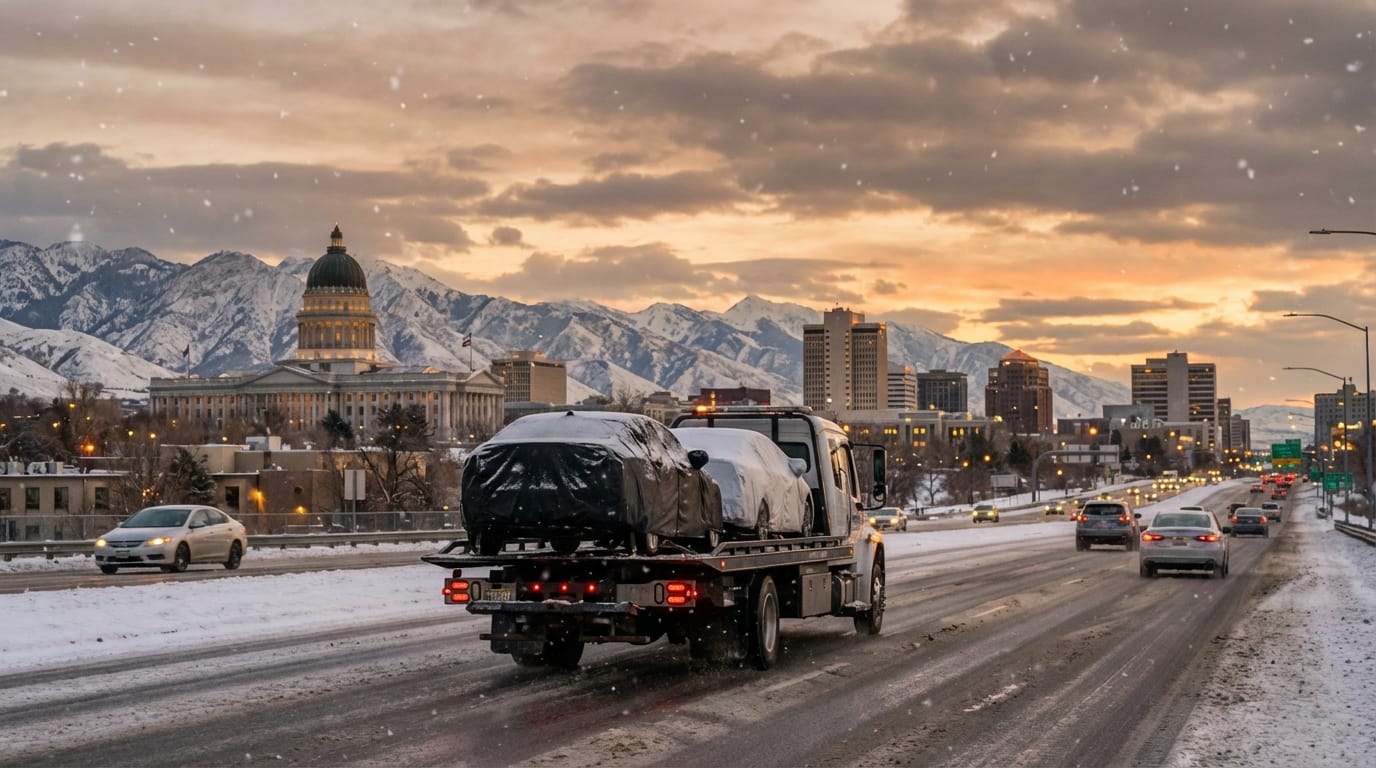
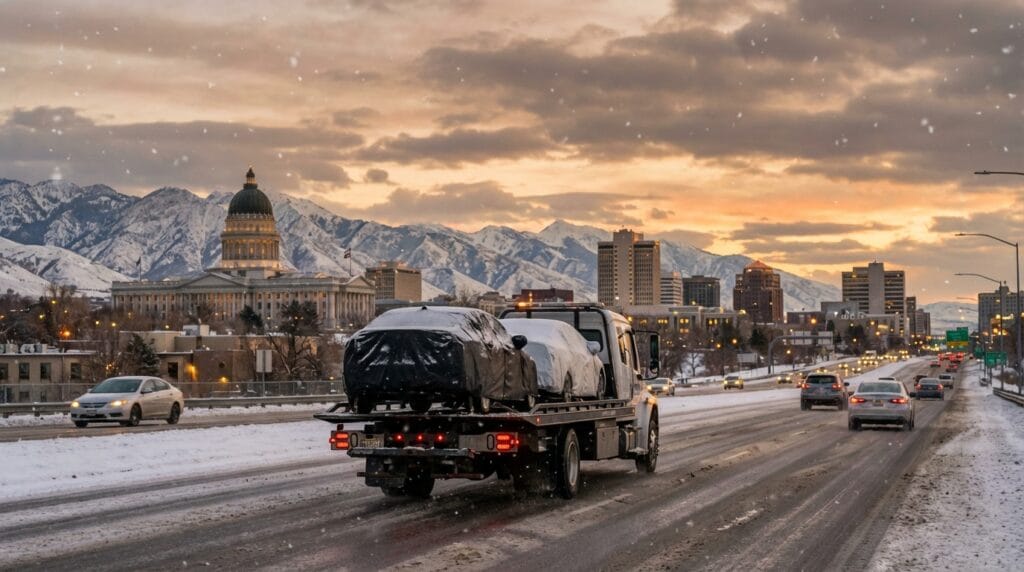
Moving a high-value asset across the Wasatch Front during a late December freeze requires significantly more precision than a standard hook-and-chain drag. We coordinate complex vehicle transport logistics to ensure your sedan, truck, or equipment arrives at its destination without magnesium chloride damage or weather-induced delays.
The Mechanics of Salt Lake Vehicle Transport
Many drivers confuse general towing with specialized vehicle transport. While they share equipment, the objectives differ fundamentally. Towing is reactive—clearing a disabled car from I-15 after a breakdown. Transport is proactive—the scheduled relocation of a vehicle from Point A to Point B, often over longer distances or for specific preservation purposes.
In Salt Lake City, this distinction is critical during winter. Transporting a vehicle involves calculating static weight loads, securing suspension geometry for long-haul stability, and protecting the chassis from the aggressive de-icing agents used by the Utah Department of Transportation (UDOT). When you hire us for transport, you aren’t just paying for a lift; you are paying for risk mitigation.
The Geographic Gauntlet Salt Lake City sits in a bowl surrounded by steep grades. Transporting a vehicle out of the valley means conquering specific choke points:
- Parleys Canyon (I-80): High elevation, frequent chain restrictions, and severe wind gusts.
- Point of the Mountain (I-15): High-speed traffic merging with unpredictable winter fog.
- Sardine Canyon (US-89/91): steep grades leading into Cache Valley, notorious for black ice.
Professional transport drivers understand how these distinct microclimates affect load stability. A sudden gust in Parleys Canyon can shift a poorly secured load, leading to catastrophic sway.
Deep Dive: Winter Logistics & Corrosion Data
The most significant threat to your vehicle during a Salt Lake winter transport isn’t a collision; it is chemical corrosion. To keep roads clear, UDOT utilizes a combination of sodium chloride (rock salt) and magnesium chloride (liquid brine). While effective for safety, these compounds are highly corrosive to automotive metals.
The Magnesium Chloride Factor Magnesium chloride is stickier than traditional rock salt. It adheres to the undercarriage of vehicles and re-activates every time it gets wet, even from humidity in a garage. If your vehicle is transported on an open carrier without proper preparation, it essentially receives a 300-mile salt bath.
Transport Method Comparison: Winter 2025
| Feature | Open Flatbed Transport | Enclosed Transport | DIY Drive (Self-Transport) |
|---|---|---|---|
| Cost | Moderate | High | Low (Fuel + Time) |
| Salt Exposure | High (Direct spray from road) | Zero (Fully shielded) | Maximum (Wheel wells/Undercarriage) |
| Debris Risk | Moderate (Rocks, ice chunks) | Zero | High |
| Mileage Added | None | None | Full trip distance |
| Safety Risk | Low (Professional driver) | Low | High (Driver fatigue/Ice) |
Load Distribution Science Transporting a vehicle changes its center of gravity dynamics compared to driving it. On a flatbed, the vehicle is static. The suspension does not compress and rebound to absorb energy in the same way it does when tires are spinning.
- Chassis Stress: Improper tie-downs can bend control arms. We use wheel nets (lassos) rather than frame chains for modern vehicles to allow the suspension to work naturally without stressing alignment components.
- Weight Transfer: In winter, traction on the tow truck is paramount. We calculate the payload placement to ensure the tow rig’s steering axle maintains sufficient ground pressure for steering on icy passes like Soldier Summit.
According to the Federal Motor Carrier Safety Administration (FMCSA), cargo securement failure is a leading cause of transport accidents [1]. In winter, cold temperatures cause metal chains to contract and nylon straps to stiffen, requiring frequent tension checks—a protocol we strictly enforce.
Actionable Steps: Preparing for Transport
Handing over your keys requires preparation. A lack of preparation can lead to disputes over damage or delays in shipment. Follow this methodology to ensure a seamless transfer.
- Document Pre-Existing Conditions
Do not rely on memory. Wash the vehicle thoroughly before the truck arrives (weather permitting). Take high-resolution photos of:
- All four corners of the bumper.
- Rocker panels (prone to stone chips).
- Odometer reading.
- Glass condition (windshield chips).
This creates an indisputable baseline for the Bill of Lading.
- Fluid and Battery Management
Winter temperatures in December often drop below freezing.
- Anti-freeze: Ensure your coolant is rated for at least -20°F. If a block cracks during transport due to freezing, carrier insurance may deny the claim as “mechanical failure” rather than transport damage.
- Fuel Level: Keep the tank at 1/4 full. This reduces total weight (saving fuel for the carrier) but leaves enough for loading/unloading and emergency idling if stuck in a road closure.
- Battery Health: A dead battery complicates loading. If your car won’t start, we have to winch it, which changes the logistical approach. If you know the battery is weak, tell us so we can bring a jump start service pack.
- Disable Toll Tags and Alarms
There is nothing worse than a car alarm screaming on the back of a flatbed for 200 miles. Disable any anti-theft systems. Remove EZ-Pass or Express Lane tags; otherwise, scanners may register your car passing under toll gantries and charge you, even though you are being hauled.
- Secure Loose Cargo
Federal regulations prohibit the transport of household goods inside a vehicle on a carrier unless the carrier has specific household goods authority. Furthermore, loose items become projectiles during hard braking. Clear the cabin.
- Verify Carrier Authority
Ask for the DOT number. You can verify our operating status and safety record via the FMCSA SAFER system. Legitimate companies are transparent about their licensing.
Nuance: The Broker vs. Carrier Debate
In the vehicle transport industry, a massive distinction exists between a broker and a carrier. Understanding this protects your wallet and your timeline.
The Broker Model Brokers do not own trucks. They post your job to a load board and take a deposit.
- Pros: Access to a nationwide network.
- Cons: No control over who actually shows up. You might get a top-tier driver or an inexperienced operator with bare-minimum insurance.
The Carrier Model (Us) We own the trucks. We employ the drivers.
- Pros: Accountability. When you call Salt Lake Towing, you speak to the people moving your car. We know our equipment and our schedule.
- Cons: Limited to our physical fleet capacity (though we prioritize local Salt Lake clients).
Counter-Argument: “I’ll just rent a dolly and tow it myself.” We hear this often. You have a truck, so why not rent a U-Haul trailer?
- The Jackknife Risk: Towing a trailer on dry pavement is a skill. Towing a trailer down Parleys Canyon on ice without trailer brakes or weight-distribution hitches is a gamble.
- Transmission Strain: Your pickup might be rated to tow 10,000 lbs, but does it have a transmission cooler? Sustained hauling up Utah grades overheats stock transmissions rapidly.
- Insurance Gaps: Most personal auto policies do not cover the “towed vehicle” if you cause an accident. You would be liable for the damage to the car you are towing.
Expert Opinion: Industry data suggests that self-transport accidents increase by 14% during winter months due to inexperienced drivers misjudging stopping distances with added weight [2]. The cost of a professional transport is often lower than the deductible on a jackknife claim.
Future Outlook: EV Transport and Tracking Tech
The landscape of vehicle transport is shifting rapidly, driven by the electrification of the fleet and customer demand for visibility.
Electric Vehicle (EV) Logistics Salt Lake City has a high adoption rate of EVs. Transporting a Tesla, Rivian, or Ford Lightning presents unique challenges:
- Weight: EVs are significantly heavier than gas cars due to battery packs. A standard flatbed that can legally carry two gas sedans might only legally carry one large EV. This affects pricing and fleet utilization.
- Range Anxiety: Cold weather reduces EV battery range. We ensure EVs are transported with sufficient charge to reach the nearest Supercharger upon unloading, accounting for “vampire drain” (battery loss while parked/off) which accelerates in the cold.
- Regenerative Braking Risks: EVs must be placed in “Tow Mode” or “Transport Mode.” Failure to do this can damage the electric motors if the wheels spin during loading.
Real-Time Telematics The days of “it will get there when it gets there” are ending. We are integrating GPS tracking that allows dispatch to see the exact location of the truck. This is vital for “Just-In-Time” deliveries to body shops or dealerships. Future trends point toward customer-facing portals where you can track your vehicle’s progress along I-15 in real-time, similar to a ride-share app.
Regulatory Changes The Department of Transportation is tightening rules on “hotshot” trucking (smaller trucks hauling cars). Increased enforcement on weight limits and Hours of Service (HOS) logs means that legitimate carriers are investing more in compliance. This pushes rates up slightly but ensures that the driver hauling your Porsche hasn’t been awake for 20 hours straight [3].
Conclusion: Secure Your Transport
Winter in Salt Lake City is unforgiving to machinery. Whether you are moving a classic car to storage, sending a college student’s car out of state, or relocating a non-running project, the logistics demand professional oversight. Don’t risk the safety of your asset—or your own safety on icy mountain passes—to save a few dollars.
We provide transparent, insured, and rugged vehicle transport solutions tailored to Utah’s specific climate challenges. From the salt-crusted lanes of I-15 to the steep grades of the canyons, we handle the heavy lifting so you don’t have to.
Ready to move? Contact our dispatch team today to schedule your transport. We prioritize safety and speed. Call Now: 801-701-1233 Get a Quote: Salt Lake Towing Services