
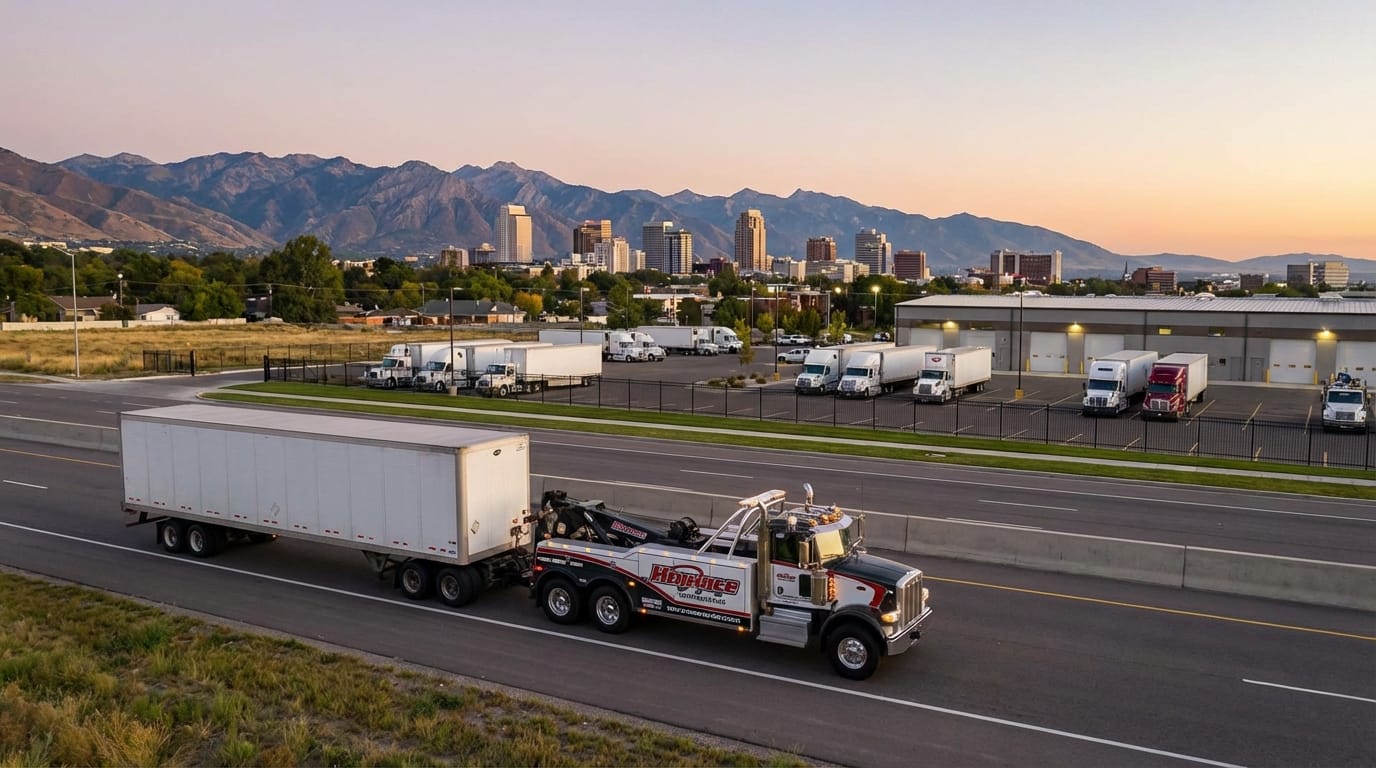
Your fleet’s profitability hinges on minimizing downtime, yet many managers treat recovery operations as an afterthought until a crisis hits. We implement strategic commercial towing protocols in Salt Lake City to protect your bottom line and reduce liability during critical mechanical failures or unauthorized parking disputes.
Defining Commercial Towing in the Wasatch Front
Commercial towing is often misunderstood as simply “towing bigger trucks.” In reality, it constitutes a specialized tier of recovery services distinct from standard consumer roadside assistance. For Salt Lake City businesses, this discipline splits into two distinct operational categories: Fleet Support and Asset Management.
Fleet Support focuses on keeping your revenue-generating vehicles moving. This involves heavy-duty recovery for semi-trucks, box trucks, and delivery vans (like the Amazon or FedEx fleets frequenting the SLC metro). It requires specialized equipment capable of lifting 80,000-pound rigs without causing secondary damage to drivetrains or fairings.
Asset Management, often termed Private Property Impound (PPI), involves managing parking compliance for commercial landowners. Whether you manage a retail complex in Sugar House or an apartment building in Murray, unauthorized vehicles create liability and reduce customer access. Utah law is extremely specific regarding signage, notification, and fee structures for PPI. Ignoring these statutes results in predatory towing lawsuits.
We operate at the intersection of these two needs. We provide the heavy wreckers needed to clear a jackknifed rig off I-80 during a canyon storm, and we supply the regulatory knowledge to manage parking enforcement without legal blowback.
The Economics of Downtime: Strategy & Data
When a commercial asset stops moving, the cost extends far beyond the tow bill. You are battling lost revenue, driver wages, missed delivery windows, and potential contract penalties. In the logistics sector, the “Cost of Downtime” is a critical KPI, yet few local fleets have a pre-arranged towing vendor to mitigate it.
The Cost of Stagnation
According to industry data, the average cost of downtime for a heavy-duty truck ranges from $448 to $760 per day, not including the repair or tow costs [1]. In a high-demand market like Salt Lake City, where logistics hubs serve as the crossroads of the West, a delayed shipment can sever client relationships.
Winter 2026 Impact: This winter has been particularly brutal for the Wasatch Front. The freeze-thaw cycles create “black ice” conditions on on-ramps and bridges. We have seen a 15% increase in commercial traction failures compared to 2024.
Fleet Recovery Data Table
The following table outlines the hidden costs associated with different commercial vehicle classes when recovery is delayed by just two hours due to poor vendor selection.
| Vehicle Class | Typical Cargo | Revenue Risk (2hr Delay) | Secondary Risks |
|---|---|---|---|
| Class 8 (Semi) | Perishables/Retail | $300 – $1,200 | Cargo spoilage, missed strict appointment windows (Walmart/Costco). |
| Class 5-6 (Box) | Local Delivery | $200 – $500 | Failed route completion, overtime pay for drivers to catch up. |
| Class 3 (Van) | Service/Parcels | $150 – $400 | Customer dissatisfaction, negative reviews, lost future contracts. |
| Construction | Heavy Machinery | $1,000+ | Crew standing idle at job site, project timeline slippage. |
Strategic Vendor Alignment Relying on a Google search during an emergency guarantees you pay “spot market” rates. Establishing a relationship with a local provider ensures priority dispatch. When Parleys Canyon closes due to a slide-off, the towing company prioritizes account holders over random callers. We prioritize our commercial partners because we understand that for you, time is literally currency.
Methodology: Actionable Steps for Fleet Managers
Securing a reliable commercial towing partner requires vetting. You cannot afford to have a tow operator learning how to disconnect a driveshaft on your $150,000 rig. Use this methodology to vet and secure your recovery operations.
- Verify Heavy-Duty Certification
Not all tow trucks can handle commercial loads. Ensure your provider operates Rotators (cranes on wheels) and heavy-duty wreckers with under-reach capabilities. A standard flatbed cannot tow a loaded cement mixer. Ask for an equipment list. We maintain a diverse fleet specifically to handle Class 6-8 vehicles.
- Audit Insurance Coverage
Commercial vehicles carry high-value cargo. Standard “on-hook” insurance policies often cap out at $100,000. If you are hauling specialized electronics or medical equipment, that coverage is insufficient. Demand a Certificate of Insurance (COI) showing at least $1 million in on-hook and general liability coverage [2].
- Establish Service Level Agreements (SLAs)
Don’t leave response times to chance. Negotiate an SLA that defines maximum ETA targets for urban vs. rural breakdowns. For example, a 45-minute target for breakdowns within the I-215 belt route is standard.
- Review Storage and Yard Security
If your truck is totaled or requires overnight storage, where does it go? A secure, lit, and monitored yard is non-negotiable to prevent cargo theft. We operate secure facilities to ensure your asset remains untouched while insurance adjusters process the claim.
- Understand Utah’s PPI Laws
If you need non-consensual towing (removing unauthorized cars from your lot), you must follow Utah Code 72-9-603. You must have specific signage posted at all entrances. We provide compliant signage consultation to ensure your enforcement is legal and defensible [3].
- Integrate Digital Dispatch
Modern commercial towing utilizes GPS integration. You should know exactly when the tow truck arrives and when your vehicle reaches the shop. We use digital dispatching to provide real-time updates, reducing the “where is my truck” anxiety that plagues fleet dispatchers.
Nuance: The “Cheapest Tow” Fallacy & Liability
A prevailing counter-argument in fleet management is that towing is a commodity—therefore, the lowest price wins. This perspective is dangerous and often more expensive in the long run.
The Damage of Inexperience Improper towing destroys commercial vehicles. If an operator tows a heavy truck from the rear without securing the steering wheel properly, or fails to pull the axle shafts on an automatic transmission, they can destroy the gearbox in five miles. The repair bill for a destroyed transmission on a commercial rig often exceeds $15,000. The $50 saved on the tow bill becomes a rounding error compared to the repair cost.
Liability in Traffic Control Commercial recovery often happens in live lanes of traffic. If a tow operator fails to set up proper Traffic Incident Management (TIM) zones—using cones, flares, and blocking vehicles—and a secondary accident occurs, your company could be named in the lawsuit. We strictly adhere to Federal Highway Administration (FHWA) TIM protocols to create safe workspaces [4]. You are hiring us not just to move a truck, but to manage a hazardous scene.
The “In-House” Debate Some large construction firms consider buying their own tow truck. While this offers control, the maintenance, insurance, and certification costs for a heavy wrecker usually outweigh the benefits unless you have a fleet of 500+ vehicles. Outsourcing transfers the liability and capital expenditure to us.
Future Outlook: EV Fleets and Autonomous Rigs
The commercial sector in Salt Lake City is shifting. We are seeing a rapid increase in electric delivery vans (Rivian, Ford E-Transit) and the early adoption of electric semi-trucks.
High-Voltage Recovery Towing an electric commercial vehicle requires specific training. You cannot simply hook up and drag an EV; the regenerative braking systems will generate electricity and fry the inverters if the wheels spin. Furthermore, damaged high-voltage batteries pose a thermal runaway risk. We are investing in specific EV handling training and equipment, including wheel-lift dollies and flatbeds capable of handling the increased weight of battery packs.
Autonomous Trucking As autonomous trucking lanes are tested in Utah, the role of the tow operator shifts to “first responder.” If an autonomous truck suffers a sensor failure, it doesn’t just pull over; it may stop in a travel lane. Recovery teams must be trained to interface with the vehicle’s computer to disengage brakes and prepare it for transport. We are monitoring these developments to remain the most technically proficient partner in the valley.
Telematics Integration By 2027, we anticipate direct integration between fleet telematics and towing dispatch. Your truck’s computer will detect a critical failure, automatically notify our dispatch system with the exact location and fault code, and dispatch the correct wrecker type without a phone call. This seamless integration will shave valuable minutes off recovery times.
Protecting Your Operations
Commercial towing is not about moving metal; it is about sustaining commerce. In Salt Lake City’s competitive market, you cannot afford to let a mechanical failure become a logistical disaster. Whether you need to clear a loading dock of unauthorized vehicles or recover a loaded semi from a snowbank, you need a partner who understands the stakes.
We provide the heavy-duty capabilities, legal compliance, and rapid response required to keep your business operational. Do not wait for the next breakdown to vet a vendor.
Secure your fleet’s uptime today. Contact Salt Lake Towing for a Fleet Consultation 24/7 Dispatch: 801-701-1233 Explore Services: Towing Services | Roadside Assistance