
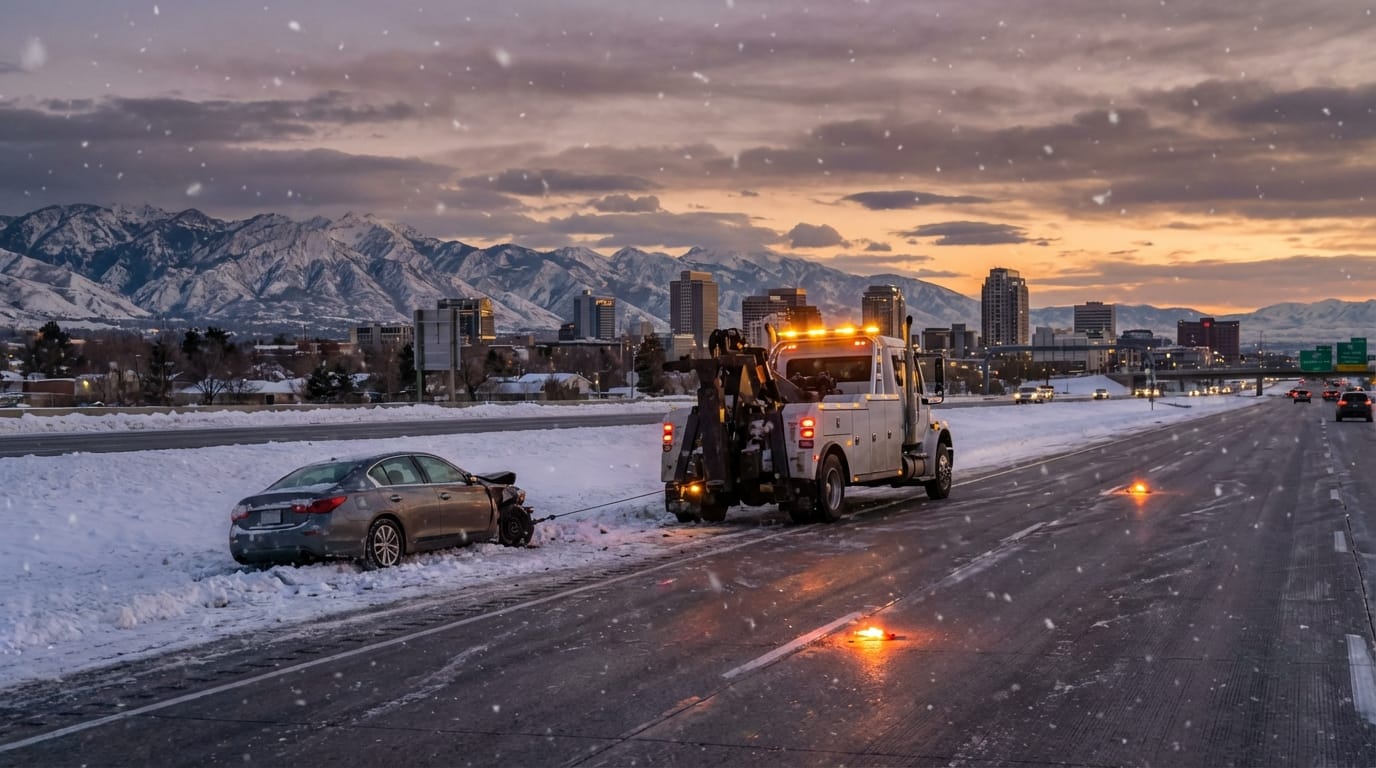
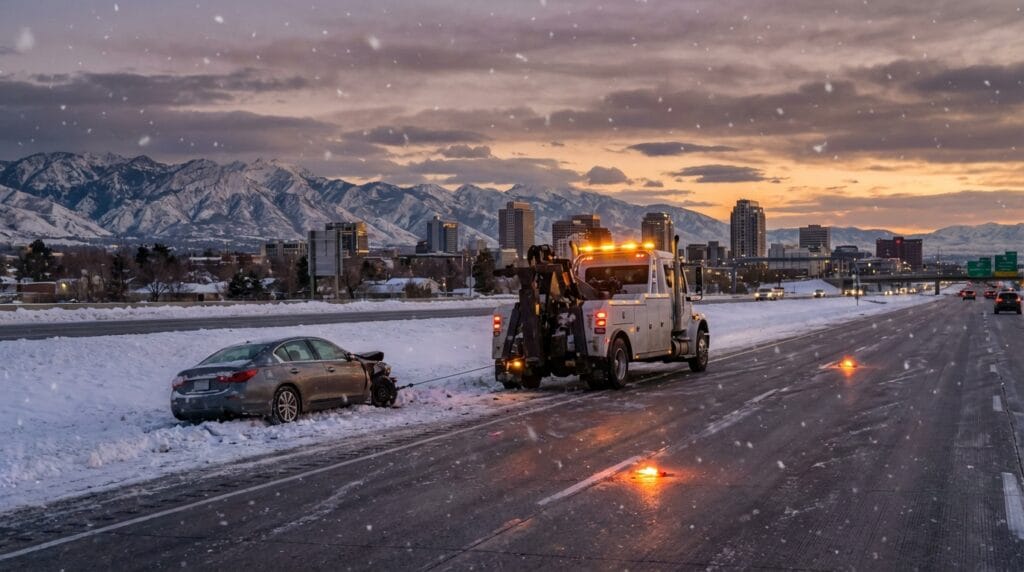
The sound of crunching metal on an icy I-15 off-ramp instantly shifts your priority from commuting to crisis management. Professional accident recovery is a calculated engineering operation designed to mitigate secondary risks, clear hazardous roadways, and preserve the integrity of your vehicle after a collision.
Key Concept & Definition: Salt Lake City Accident Recovery
Accident recovery differs fundamentally from standard towing. While a standard tow involves transporting a mechanically disabled vehicle from point A to point B, recovery involves complex rigging, site remediation, and traffic control to extract a vehicle from a compromised position. In Salt Lake City, this often means retrieving vehicles from snow-packed ravines in Big Cottonwood Canyon or uprighting overturned semi-trucks on the wind-swept stretches of I-80 near the Great Salt Lake.
True recovery requires a distinct set of certifications. Operators must understand the physics of resistance, working load limits (WLL), and the structural integrity of modern vehicle frames. When we arrive at a crash site, we are not just truck drivers; we are problem solvers managing kinetic energy and hazardous materials. The goal is to return the roadway to normal flow while preventing further damage to the casualty vehicle, a process that demands precision over speed.
Recovery Strategy & Critical Data
Understanding the scope of accident recovery requires looking at the raw data regarding winter collisions in Utah. The topography of the Wasatch Front creates a unique high-risk environment for drivers, particularly during the months of December through March.
Utah Crash Statistics & Environmental Factors
Data from the Utah Department of Public Safety indicates that speed and weather are compounding factors in over 40% of winter accidents [1]. The friction coefficient on icy roads in Parleys Canyon drops drastically, turning minor driving errors into multi-car pileups.
Comparative Analysis: Standard Tow vs. Accident Recovery
| Feature | Standard Towing | Accident Recovery |
|---|---|---|
| Primary Goal | Transport vehicle to shop/home. | Extract, stabilize, and clear hazard. |
| Equipment | Flatbed or Wheel-lift truck. | Rotator, Heavy Wrecker, Air Cushions. |
| Skill Set | Loading and securing. | Rigging physics, Hazmat control. |
| Timeframe | Scheduled or non-urgent. | Immediate emergency response. |
| Cost Factors | Mileage and hook-up fee. | Hourly labor, rigging, site cleanup. |
| Risk Level | Low to Moderate. | High (traffic proximity, fluid leaks). |
The Physics of Extraction
Successful recovery relies on the calculation of “mire resistance.” If your truck is buried to the wheels in mud or snow off I-215, the force required to pull it out is not equal to the truck’s weight. It can be 100% or more of the vehicle’s gross weight depending on the depth of the mire. We utilize mechanical advantage systems—snatch blocks and pulleys—to multiply the pulling power of our winches without snapping lines. A 10,000 lb vehicle buried in a snowbank might require 20,000 lbs of force to extract. Ignoring these math problems results in snapped cables and flying debris.
Actionable Steps & Methodology
When a collision occurs, the immediate actions you take impact the safety of the scene and the success of the recovery.
- Scene Assessment and Safety
Before calling anyone, assess the immediate threat. If the vehicle is smoking or in a blind spot on a canyon curve, evacuate to a safe location behind a guardrail. Do not stand directly in front of or behind the vehicle. In Salt Lake City winters, visibility is often near zero; staying inside a disabled car on the shoulder of I-15 is statistically dangerous.
- Contacting Emergency Services & Dispatch
Call 911 if there are injuries or if the road is blocked. Then, contact a certified recovery provider. Be specific about your location. “I’m on the highway” is insufficient. Use mile markers, exit numbers, or dropped pins. Tell the dispatcher if the vehicle is overturned, off the road, or leaking fluids. This dictates whether we send a standard flatbed or a heavy-duty wrecker.
- The Recovery Plan Formulation
Upon arrival, our operators conduct a 360-degree survey. We identify anchor points—parts of the chassis strong enough to handle pulling force. Modern unibody cars have specific recovery points; hooking onto a suspension arm can rip the axle clean off. We create a rigging plan that accounts for the vehicle’s center of gravity to prevent flipping it during the pull.
- Rigging and Extraction
We attach chains or synthetic straps to the identified anchor points. For rollovers, we may use airbag recovery systems to gently lift the vehicle upright without crushing the roof. This is critical for preserving the vehicle for insurance adjusters. Once upright and back on the pavement, we secure the vehicle for transport.
- Site Remediation
Accidents leave scars on the road. Broken glass, plastic debris, and spilled coolant must be removed. Leaving debris is a liability and a hazard to other motorists. We sweep the area and apply absorbents to slick fluids, ensuring the lane is safe for reopening.
Nuance, Counter-arguments & Expert Opinions
The recovery industry is not without its controversies and complexities, especially regarding cost and regulation.
The “Chaser” Problem
A significant issue in the towing industry is “accident chasing.” This occurs when tow trucks appear at a crash scene without being requested by the police or the vehicle owner. These operators often monitor police scanners and race to scenes to secure the tow, subsequently charging exorbitant storage and recovery fees. Expert Opinion: The Towing and Recovery Association of America (TRAA) advises motorists to never accept a tow from a truck they did not call or that was not dispatched by law enforcement [2]. In Utah, you have the right to choose your recovery service unless you are blocking a live lane of traffic and police determine an immediate tow is necessary for public safety.
Insurance Friction
Vehicle owners often assume their insurance covers “everything.” However, many policies have caps on towing and labor. A complex recovery involving a rotator crane and three hours of labor can exceed standard roadside assistance limits. Counter-argument: Some insurers argue that high recovery bills are inflated. Our Stance: Recovery billing reflects the immense capital investment in heavy-duty equipment (a rotator can cost over $800,000) and the high risk to operators working inches from speeding traffic. We provide itemized invoices to justify every action taken, from winching to debris removal, helping you advocate for full reimbursement.
Electric Vehicle (EV) Complications
Salt Lake City has a high adoption rate of EVs. Recovering a Tesla or Rivian after a crash introduces lethal risks. Damaged high-voltage batteries can enter “thermal runaway,” catching fire hours or days after the impact. Nuance: Standard towing methods (towing with wheels on the ground) can destroy an EV’s electric motors due to regenerative braking systems generating power with nowhere to go. We utilize specialized dollies or flatbeds exclusively for EVs and monitor battery temperature throughout the recovery process [3].
Future Outlook & Trends
The landscape of accident recovery is shifting with automotive technology.
Telematics and Automated Dispatch
By 2026, more vehicles will automatically transmit crash data directly to recovery networks. This data includes the force of impact, the number of airbags deployed, and the vehicle’s precise orientation. This allows us to dispatch the exact right equipment before we even speak to the driver, reducing clearance times on critical arteries like I-80.
Autonomous Recovery Tech
We are beginning to see the integration of drone technology for scene assessment. In difficult terrain like the Wasatch back-country, sending a drone to survey a vehicle over a cliff edge allows us to plan the rigging without risking a human life on an unstable slope.
Regulatory Tightening on EV Handling
Expect stricter regulations from the Department of Transportation regarding the storage of crashed EVs. Tow yards may soon require dedicated “quarantine zones” with fire suppression systems for damaged electric vehicles, a standard we are already preparing for to ensure compliance and safety.
Conclusion & Next Steps
Winter in Salt Lake City demands respect for the road and readiness for the worst. Accident recovery is a specialized service that goes far beyond hooking a chain to a bumper. It requires physics, patience, and professional equipment to ensure that a bad day doesn’t turn into a financial or legal nightmare.
If you find yourself sliding off the road or involved in a collision, prioritize safety and professional help. Do not let an amateur make the situation worse. We are equipped to handle everything from minor fender benders downtown to complex recoveries in the canyons.
For immediate dispatch in the Salt Lake Valley: Call 801-701-1233 Visit our About Us page for more on our certifications.
We also specialize in roadside assistance and standard towing services if your situation is less critical but still requires expert care.