
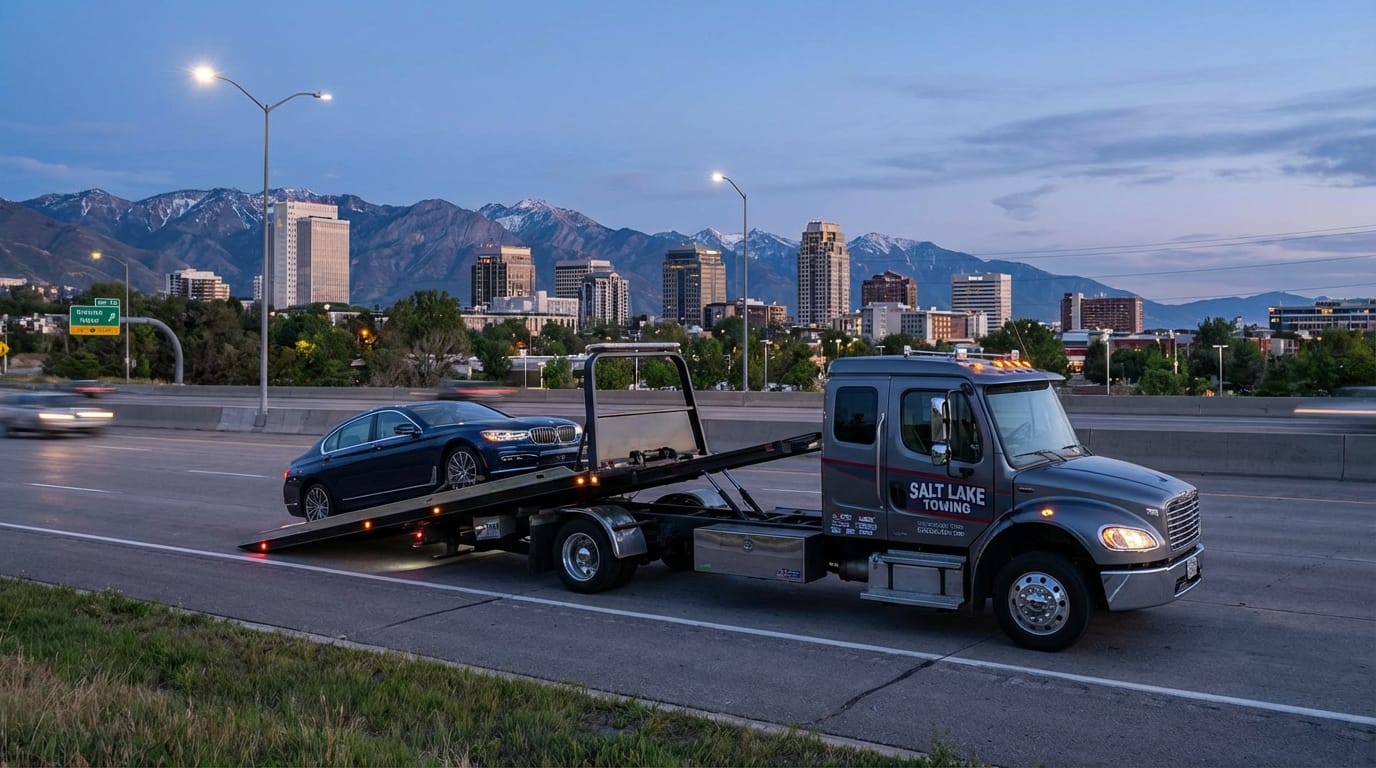
It is November 30, 2025, and the first major winter storms are hitting the Wasatch Front, turning I-15 into a slick, hazardous commute. If your AWD vehicle slides off the road near Parleys Canyon, the type of tow truck you call matters just as much as getting rescued. Choosing flatbed towing is the only way to ensure your vehicle’s transmission survives the trip to the mechanic without sustaining thousands of dollars in secondary damage.
Key Concept & Definition
At its core, flatbed towing involves a specialized truck equipped with a large, flat hydraulic bed that can be inclined and lowered to ground level. Unlike a “hook-and-chain” or “wheel-lift” truck that drags your vehicle with two wheels on the pavement, a flatbed winches your entire car onto the platform. Once secured, all four wheels are stationary and off the ground.
This distinction is critical for the Salt Lake City market. Because our region has one of the highest concentrations of All-Wheel Drive (AWD) and 4-Wheel Drive (4WD) vehicles in the nation—necessitated by our canyon roads and [1]—dragging these cars behind a truck causes the wheels to spin while the engine is off. This forces the transmission components to turn without proper lubrication, leading to catastrophic drivetrain failure.
Deep Dive into Strategy & Data
Many drivers assume all towing methods are equal, but the mechanical reality of modern vehicles proves otherwise. In Salt Lake City, where “Subaru country” meets steep inclines, the wrong tow can total a car faster than a fender bender. Here is why the strategy of using a flatbed is non-negotiable for most Utah drivers:
- The AWD Mechanics: AWD systems, like those found in Subarus and Audis, use a center differential to distribute power. If two wheels are dragged while two are stationary, the center differential attempts to compensate for the speed difference, causing it to overheat and burn out within miles [2].
- EV Regenerative Braking: With the rise of Electric Vehicles (EVs) in neighborhoods like Sugar House and the Avenues, towing has changed. EVs lack a true “neutral” gear in the mechanical sense. Dragging an EV can generate electricity through the motor, back-feeding into the battery and frying the high-voltage inverters [3].
- Winter Clearance Issues: In deep Utah snow, a car being towed by its front wheels leaves the rear bumper dragging at a steep angle. This often causes the rear fascia to scrape against ice chunks or pavement, ripping off bumpers or exhaust systems.
Risk Analysis: Flatbed vs. Traditional Dolly Towing
| Feature/Risk | Wheel-Lift (Dolly) Towing | Flatbed Towing |
|---|---|---|
| AWD/4WD Safety | Severe Risk (Requires drivetrain disconnect) | 100% Safe (No wheels spin) |
| EV Compatibility | Not Recommended (Inverter damage risk) | Manufacturer Required |
| Ground Clearance | Low (Rear bumper may drag) | High (Entire car is elevated) |
| Setup Speed | Fast (Quick hook-up) | Moderate (Requires winching) |
| Transmission Risk | High (If not in true neutral) | Zero |
Actionable Steps & Methodology
If you find yourself stranded on Bangerter Highway or stuck in a snowy driveway, follow these steps to ensure you get the right service and protect your asset:
- Identify Your Drivetrain: Before calling, confirm if your vehicle is AWD, 4WD, RWD, or FWD. If you see badges like “Quattro,” “X-Drive,” or “Symmetrical AWD,” you must request a flatbed.
- Check the Owner’s Manual: Look under the “Emergency Towing” section. Manufacturers like Subaru explicitly state that “towing with all wheels on the ground” or “using a tow dolly” is prohibited and will void warranties [2].
- Expose the Tow Eyelet: Modern cars often have a small square cutout in the front bumper. Pop this cover off and screw in the tow hook (usually found in your trunk with the spare tire). This gives the flatbed operator a safe winching point, preventing damage to your suspension arms.
- Request “Flatbed Only”: When you call for roadside assistance, do not leave it up to chance. Explicitly state: “I have an AWD vehicle and require a flatbed truck.”
- Disable Auto-Parking Brakes: Many modern cars automatically engage the parking brake when the engine turns off. Ensure you know how to override this electronically so the car can roll onto the truck bed freely.
Nuance, Counter-arguments & Expert Opinions
Is flatbed towing always the superior choice? Not necessarily. It is important to acknowledge that wheel-lift trucks still have a place in the industry. For short-distance tows of 2-wheel drive (FWD) sedans—like moving a Toyota Camry from a parking garage to a nearby shop—a wheel-lift is often faster, more nimble in tight spaces, and slightly more cost-effective.
However, expert consensus from organizations like AAA and the NHTSA suggests that the margin for error with wheel-lift towing is shrinking. As vehicles become more complex, with lower ground clearances and sophisticated transmissions, the “safe bet” is increasingly the flatbed [4]. Furthermore, in winter conditions where ice ruts are common, the flatbed offers the added benefit of keeping your vehicle completely out of the corrosive salt spray and road debris during transport.
Future Outlook & Trends
The towing industry in Salt Lake City is evolving rapidly alongside automotive technology. We are observing a significant shift driven by the electrification of the vehicle fleet. By late 2025, heavy electric trucks (like the Rivian or Ford Lightning) are becoming common sights in the canyons. These vehicles curb weight often exceeds 7,000 lbs, pushing the limits of traditional tow trucks.
Future trends indicate a move toward heavy-duty flatbeds with higher load capacities and specialized “soft-touch” strapping systems that secure vehicles by the tires rather than the chassis [5]. This prevents alignment damage in vehicles with air suspension systems. As 800-volt battery architectures become standard, the strict requirement for flatbed towing will only become more universal, making the “hook-and-chain” truck a relic for anything other than scrap hauling.
Conclusion & Next Steps
Winter in Salt Lake City is unforgiving on vehicles, and the decision you make during a breakdown can save—or cost—you thousands in repairs. Don’t let a simple tow turn into a transmission replacement. By choosing flatbed towing, you ensure that your AWD SUV, luxury sedan, or electric vehicle arrives at the shop in the exact same condition it left the road.
If you are stuck in the snow or facing a mechanical failure anywhere in the Salt Lake Valley, skip the risk. Contact Salt Lake Towing immediately. We prioritize the safety of your drivetrain with our modern fleet of flatbed trucks.
Need a safe tow right now?