
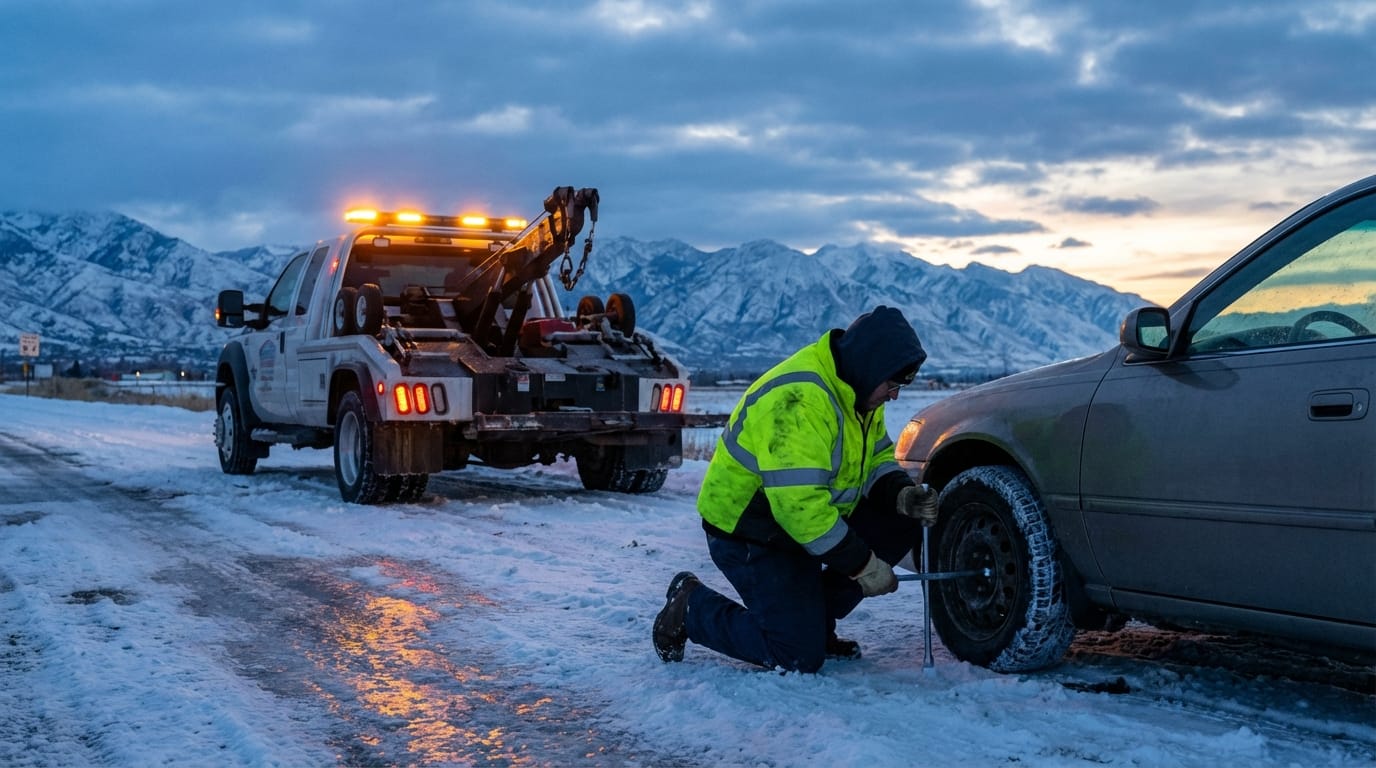
You know the sound—the sudden, rhythmic thud-thud-thud against the asphalt while you’re merging onto I-15 near the Spaghetti Bowl. When you need a tire change service in Salt Lake City during winter, you aren’t just dealing with a mechanical nuisance; you are managing a high-stakes safety scenario involving sub-zero temperatures, heavy vehicle traffic, and modern automotive engineering complexities.
The Salt Lake City Winter Context
Changing a tire in July on State Street is an annoyance; changing one in January on the shoulder of I-80 near Parleys Canyon is a tactical operation. Salt Lake City presents a unique “corrosion corridor” for vehicles. The excessive use of road salt and magnesium chloride to combat ice creates a chemical environment that fuses lug nuts to wheel studs.
When the temperature drops below freezing, metal contracts. While the thermal contraction of a steel bolt is microscopically small, the combination of contraction, rust, and road grime can seize a wheel so tightly that the standard lug wrench included with your car becomes useless. We frequently encounter drivers who have snapped their factory-issued tools trying to break a frozen lug nut loose. Furthermore, the “slip and slide” risk of using a mechanical scissor jack on an icy shoulder cannot be overstated. A vehicle slipping off a jack doesn’t just damage the rotor; it endangers your life.
Critical Data: The “Spare Tire Deficit”
If you bought a car in the last five years, there is a 30% chance you don’t even have a spare tire [1]. Manufacturers, driven by federal fuel economy standards, have been shedding weight by eliminating the spare tire, jack, and lug wrench. Instead, they provide “inflator kits” or equip cars with run-flat tires.
This shift has fundamentally changed the nature of roadside assistance. We are no longer just swapping wheels; we are often diagnosing whether a tow is the only option because the “backup plan” in your trunk is a bottle of frozen sealant.
The Spare Tire Hierarchy in Modern Vehicles
| Equipment Type | Prevalence (New Cars) | Winter Effectiveness | Major Risk Factor |
|---|---|---|---|
| Full-Size Spare | < 10% (Trucks/SUVs) | High | Heavy to lift; requires high ground clearance to install. |
| Donut (Compact) | ~60% | Moderate | Unsafe at speeds >50mph; poor traction on snow/ice. |
| Inflator Kit | ~30% | Low (Fail rate high) | Sealant freezes; useless on sidewall blowouts. |
| Run-Flat Tires | Luxury Models | Moderate | Stiff sidewalls crack in extreme cold; expensive to replace. |
Methodology: The Professional Protocol
When we arrive on the scene for a flat tire repair, we follow a strict safety and mechanical protocol that differs significantly from a DIY attempt.
- Site Stabilization
The first step isn’t touching the tire; it’s securing the zone. On highways like I-215, we position our truck to create a physical barrier between your vehicle and oncoming traffic. If you are in a blind spot or on black ice, we do not change the tire there. We tow you to the nearest flat lot. No tire is worth a collision.
- Hydraulic Lift vs. Scissor Jack
Factory scissor jacks are prone to collapse on uneven or slick surfaces. We use high-tonnage hydraulic floor jacks that provide a stable base, even on packed snow. This is critical for heavy SUVs and trucks common in Utah.
- Torque Management
We use impact wrenches to break seized lugs, but we use calibrated torque wrenches to tighten them. Tightening a lug nut “as hard as you can” in 10°F weather can stretch the bolt or crack the alloy wheel. We adhere to manufacturer torque specs (usually 80-140 ft-lbs) to ensure the wheel stays on without warping the rotor.
- The EV Factor
Salt Lake City has a high adoption rate of Electric Vehicles (EVs). EVs are significantly heavier than gas cars due to battery weight. A Tesla Model X or Rivian requires specific jack points to avoid puncturing the battery pack. A standard jack placed in the wrong spot can cause thousands of dollars in damage [2]. Our drivers are trained on EV lift points.
Nuance: Why “Just Air It Up” Fails
A common misconception is that a can of “Fix-a-Flat” is a universal cure. In our industry, we see the aftermath of this error daily.
The Sealant Trap Tire sealants are liquid. In Utah’s January lows, that liquid becomes viscous sludge. If it does manage to enter the tire, it often pools at the bottom, creating a severe imbalance that makes the car shake violently at speed. Moreover, the chemical composition can destroy the Tire Pressure Monitoring System (TPMS) sensor inside the wheel, turning a $20 patch job into a $150 sensor replacement.
The Run-Flat Reality Run-flat tires are designed to drive with zero air pressure for roughly 50 miles. However, once a run-flat has been driven on with zero pressure, its internal structure is compromised. Most reputable tire shops in SLC will refuse to repair a run-flat that has been driven on; they will require you to buy a new tire. If it’s Sunday night, you aren’t getting a new tire. In this scenario, Salt Lake Towing provides the bridge—towing you home or to a shop to wait for opening hours.
Future Outlook: Airless Tech & Mobile Service
The tire industry is pivoting. Michelin and GM are testing the “Uptis” airless tire system, which could render flat tires obsolete by 2030. Until then, the trend is moving toward mobile tire installation. We are seeing a rise in demand for “mount and balance” services performed on the roadside, though currently, this is limited by weather conditions (mounting a tire in a blizzard is technically unfeasible).
For now, the focus remains on rapid response. As vehicle weight increases with electrification and spare tires disappear, the reliance on professional roadside assistance will only grow. The “simple” tire change is becoming a specialized service requiring heavy-duty equipment and technical knowledge of vehicle lift points.
Getting Back on the Road
A flat tire in a Salt Lake winter is more than an inconvenience; it is a safety hazard that demands respect. Whether you are dealing with a seized lug nut, a missing spare, or a dangerous location on the freeway, the priority is always human safety over vehicle preservation.
If you hear that thud, pull over safely. Check your trunk. If you see an inflator kit instead of a spare, or if the lugs are frozen solid, don’t risk frostbite or injury fighting the vehicle. We have the equipment to lift, swap, or tow your vehicle safely, ensuring you get out of the cold and back to your life.
Contact Us for Immediate Assistance:
- Location: Serving Salt Lake City and surrounding metro areas.
- Phone: 801-701-1233
- Service: Request Help Now
Sources
- AAA. “The Disappearing Spare Tire.” AAA Newsroom, 2023
- Consumer Reports. “The Hidden Dangers of EV Weight.” Consumer Reports, 2024
- UDOT. “Winter Driving Safety & Crash Statistics.” Utah Department of Transportation, 2024
- NHTSA. “Tire Safety and Maintenance.” National Highway Traffic Safety Administration