
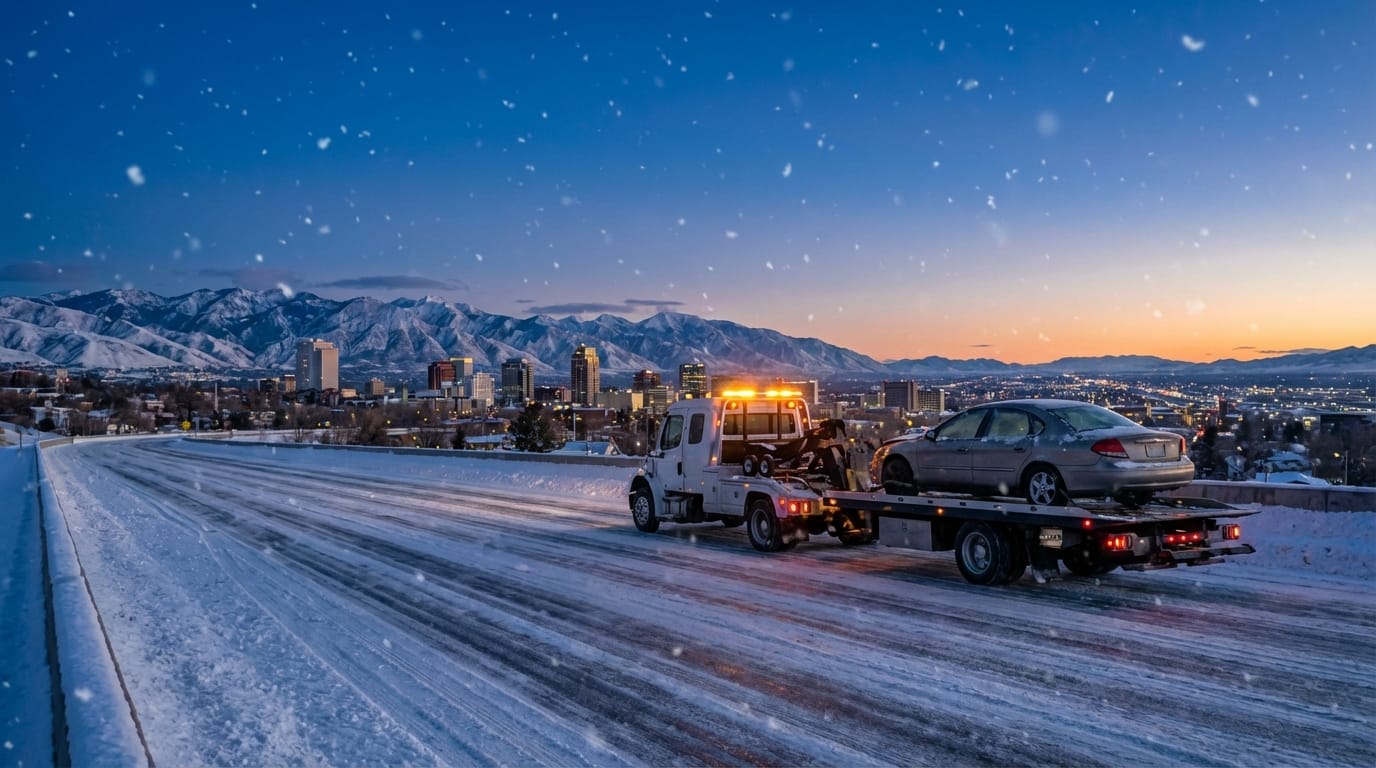
Moving a vehicle across state lines in January demands more than just a hitch and a prayer; it requires calculated logistics and heavy-duty hardware. We specialize in long distance towing that navigates Utah’s treacherous winter passes with precision and certified safety protocols.
Key Concept & Definition: The Salt Lake Logistics Hub
Long distance towing isn’t simply a standard tow that lasts longer. In the industry, we define this as any transport exceeding 100 miles or crossing state lines. For Salt Lake City residents, this definition is dictated by geography. To the west, you have the expanse of the Salt Flats leading to Wendover; to the east, the steep, often icy grades of Parley’s Canyon heading toward Park City and Wyoming.
We operate as a critical logistics node in the Intermountain West. Unlike a local breakdown where the goal is the nearest shop, a long-haul transport is a planned event. It involves moving a vehicle from Point A to Point B without adding mileage to the odometer or stress to the drivetrain. This service is essential for relocating classic cars, transporting vehicles for snowbirds heading to St. George or Arizona, or moving non-running assets to specialized repair facilities in Denver or Las Vegas.
The primary differentiator here is the jurisdiction and equipment. Local towing operates under municipal and state regulations. Once we cross into Nevada, Idaho, or Wyoming, we adhere to Federal Motor Carrier Safety Administration (FMCSA) rules regarding hours of service and interstate commerce. You aren’t just hiring a driver; you are hiring a federally regulated carrier.
Deep Dive into Strategy & Data: Winter Routes and Cost Reality
January in Utah changes the physics of towing. The friction coefficients on I-15 drop drastically, and wind gusts in the canyons can turn a standard trailer into a sail. We analyze route viability in real-time. A trip to Evanston, Wyoming, might look short on a map, but during a winter inversion or storm, it becomes a high-stakes operation.
The Cost of Mileage vs. Risk
Many customers look strictly at the “price per mile.” This is a flawed metric. The true cost involves the risk profile of the route. Towing a vehicle through the Virgin River Gorge on the way to Las Vegas involves different wear, fuel consumption, and insurance liabilities than a straight shot north to Ogden.
We utilize a dynamic pricing strategy that accounts for:
- Fuel Volatility: Diesel prices fluctuate. Long hauls require massive fuel consumption, often averaging 6-8 miles per gallon under load.
- Route Difficulty: Mountain passes require chains, slower speeds, and higher driver fatigue management.
- Return Logistics: “Deadhead” miles (driving back empty) are factored into the quote.
Data Table: Local vs. Long Distance Risk Factors (Jan 2026)
| Factor | Local Towing (SLC Metro) | Long Distance (Interstate) |
|---|---|---|
| Average Speed | 35-45 MPH | 60-70 MPH (Weather Permitting) |
| Road Hazards | Traffic congestion, potholes | Black ice, high winds, driver fatigue |
| Vehicle Stress | Minimal (short duration) | High (vibration, salt spray exposure) |
| Insurance Type | On-hook liability (Local) | Cargo liability + Interstate filings |
| Est. Duration | 1-2 Hours | 6-48 Hours |
The “Salt Spray” Factor
One specific data point we track is corrosion exposure. In January, UDOT sprays millions of gallons of brine on I-15. If your vehicle is towed on a dolly (two wheels down) or an open flatbed for 300 miles, it is being power-washed with salt water. We recommend specific post-tow wash protocols or enclosed transport for high-value assets to mitigate this [1].
Actionable Steps & Methodology: Securing the Load
Successful long-haul transport requires preparation from both us and you. We don’t just hook up and drive away. We follow a rigid methodology to ensure the vehicle arrives in the exact condition it left.
- Remove Personal Belongings
Items left inside a vehicle are not covered by carrier insurance. A laptop bouncing around in the back seat of a car being towed at 65 MPH can damage the upholstery or crack a window. Remove all loose items. If you must leave items, lock them in the trunk, but understand they travel at your own risk.
- Disable Alarms and Anti-Theft Systems
Nothing drains a battery faster than a car alarm triggering every time the tow truck hits a bump on I-80. We require you to disable these systems. If an alarm sounds continuously during a 400-mile trip, the driver may have to disconnect the battery, which can reset your vehicle’s computer settings.
- Check Fluid Levels and Tire Pressure
Even if the car isn’t running, leaks can be disastrous. A slow oil leak can coat the bed of our truck or, worse, blow back onto the vehicle behind us on the highway. We inspect the undercarriage before loading. Ensure tires are inflated; low pressure can cause strap loosening as the tire compresses under dynamic load.
- Photograph the Vehicle
We take photos at the pickup point. You should too. Capture the odometer, all four corners, and the roof. This establishes a baseline for the condition of the vehicle. In the unlikely event of a rock chip or scratch, these timestamps are irrefutable evidence.
- Verify Drop-Off Logistics
If you are shipping a car to a dealership or a private residence in another state, is someone there to receive it? We cannot leave a vehicle on a public street in a different municipality without a signature. Arranging a specific delivery window is critical to avoid storage fees or redelivery charges.
Nuance, Counter-arguments & Expert Opinions
A common counter-argument we hear is: “Why shouldn’t I just rent a dolly and tow it myself?”
The DIY Fallacy
On paper, renting a tow dolly seems cheaper. However, most consumer-grade trucks are not equipped for the tongue weight of a loaded dolly on steep grades like Soldier Summit.
- Braking Physics: A dolly typically lacks independent brakes. Your towing vehicle must absorb the stopping momentum of two vehicles. On icy January roads, this is a recipe for a jackknife.
- Transmission Heat: Towing heavy loads over long distances cooks transmissions. The money saved on a tow bill often evaporates when you have to rebuild your transmission three months later.
Flatbed vs. Wheel-Lift for Long Hauls
Industry experts almost universally agree that flatbed towing is superior for long distances [2].
- Wheel-Lift (Dolly): cheap and agile for short city hops. For long distance, it puts wear on the rear tires and suspension components of the towed vehicle. It also alters the aerodynamics, increasing drag.
- Flatbed: The vehicle is completely static. No tires are spinning; no suspension parts are cycling. It is the only responsible choice for All-Wheel Drive (AWD) vehicles, which are prevalent in Utah. Towing an AWD vehicle with wheels on the ground can destroy the center differential in less than 50 miles.
The “Open vs. Enclosed” Debate
While we operate open flatbeds, we acknowledge the argument for enclosed transport. For standard vehicles, the cost premium of enclosed transport (often 50-70% higher) is rarely justified. The “road grime” accumulated on an open bed is easily washed off. Enclosed is strictly for collector-grade vehicles where even a single rock chip is a financial catastrophe.
Future Outlook & Trends: The Connected Tow
The towing industry is undergoing a digital overhaul. We are moving toward total transparency in long-distance logistics.
Real-Time Asset Tracking
By late 2026, we anticipate standardizing client-facing GPS links. You won’t have to wonder where your vehicle is between Salt Lake City and Boise. You will see a live dot on the map, complete with speed and ETA. This technology mirrors the ride-share experience but for industrial transport [3].
EV Transport Challenges
Electric Vehicles (EVs) are heavier than their combustion counterparts due to battery packs. This reduces the payload capacity of standard tow trucks. As EV adoption grows in SLC, we are upgrading our fleet to heavier chassis cabs to handle the weight legality of transporting an electric truck or SUV across state lines. Furthermore, EVs cannot be towed with wheels on the ground due to regenerative braking motors; they must be flatbedded. This cements the shift away from dolly towing for modern fleets.
Autonomous Logistics
While fully autonomous tow trucks are years away, driver-assist technologies are already here. Lane-keeping assist and adaptive cruise control for heavy rigs improve safety on the monotonous stretches of I-80 across the Salt Flats, reducing driver fatigue and accident risk.
Final Mile Logistics
Transporting a vehicle out of Salt Lake City in the dead of winter is a task for professionals, not a DIY experiment. We mitigate the risks of ice, grade, and distance so your vehicle arrives ready to drive. Whether you need specialized transport for a luxury sedan or help after unexpected breakdowns miles from home, we have the fleet to handle the haul.
Don’t risk your transmission or your safety on a snowy pass. Call Salt Lake Towing to schedule your transport.