
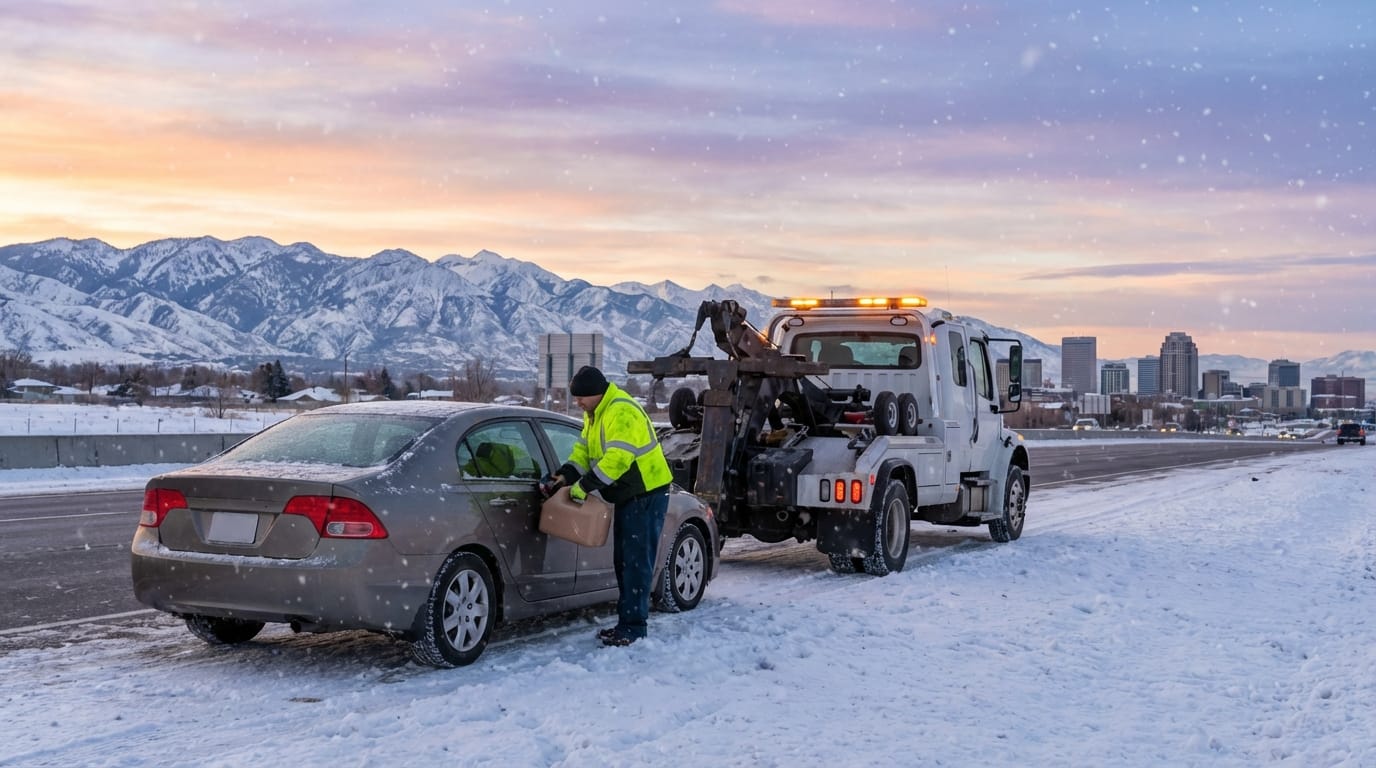
Ignoring the low fuel warning light during a Salt Lake City inversion isn’t just an inconvenience; it is a direct threat to your safety and your vehicle’s fuel pump longevity. When you are stranded on the shoulder of I-15 in January, professional fuel delivery becomes a critical lifeline rather than a simple convenience service.
The Physics of an Empty Tank in Utah Winters
Most drivers in Salt Lake City view the gas gauge as a simple suggestion. However, running low on fuel in sub-freezing temperatures creates mechanical hazards specific to our high-altitude environment. The primary issue is not merely running out of combustible liquid; it is the introduction of condensation into your fuel system.
When your gas tank is low, the empty space is filled with air. In Salt Lake City, temperatures fluctuate drastically between day and night—often swinging 20 to 30 degrees. This thermal cycling causes the moisture in that air to condense on the inner walls of your fuel tank. Water is heavier than gasoline, so it sinks to the bottom where the fuel pickup is located.
If this water enters your fuel lines when the temperature drops below 32°F, it freezes. This creates an ice blockage that mimics running out of gas, but adding more fuel won’t immediately solve it. You are dead in the water until that line thaws. This phenomenon is significantly more common in vehicles that habitually run with less than a quarter tank during January and February.
The Diesel Gelling Factor
For the heavy-duty trucks and diesel passenger vehicles common in Utah, the risk is different. Diesel fuel contains paraffin wax. As ambient temperatures drop, this wax crystallizes, turning the fuel into a gel-like sludge that cannot pass through the fuel filter. This is known as the “cloud point.” In Salt Lake City’s canyons, where temperatures are often 10 degrees colder than the valley floor, untreated diesel can gel rapidly, leaving you stranded with a full tank that simply won’t flow.
Strategic Fuel Management & Consumption Data
Understanding how long your vehicle can sustain you during a winter breakdown is vital. Many drivers overestimate how long they can idle for heat once the “Empty” light illuminates. In a standstill traffic jam on I-80—common during winter storms—this miscalculation leads to hypothermia risks.
Modern vehicles consume significantly more fuel while idling than older models due to higher electrical loads from seat heaters, defrosters, and complex climate control systems.
Winter Idling Fuel Consumption Table
| Vehicle Type | Engine Size | Est. Fuel Burn (Gal/Hour) | Est. Time to Empty (from Light On)* |
|---|---|---|---|
| Compact Sedan | 2.0L 4-Cyl | 0.16 – 0.3 | 5 – 7 Hours |
| Mid-Size SUV | 3.5L V6 | 0.4 – 0.6 | 3 – 4 Hours |
| Full-Size Truck | 5.3L – 6.2L V8 | 0.8 – 1.1 | 1.5 – 2.5 Hours |
| Heavy Duty Diesel | 6.7L Turbo | 1.0 – 1.4 | 1 – 2 Hours |
\Estimates based on typical “reserve” capacity of 1-2 gallons when light activates. Cold weather increases burn rate due to engine thermal management.*
The data indicates that a full-size truck owner stuck in a blizzard in Parley’s Canyon has a dangerously short window of safety if they enter the canyon with the fuel light on. The engine requires fuel not just to move, but to generate the heat necessary to keep the cabin survivable.
According to the U.S. Department of Energy, idling a heavy-duty truck can burn up to a gallon of fuel per hour [1]. In a severe winter event where rescue times may extend due to road conditions, that single gallon in your reserve tank is your only barrier against freezing temperatures.
Protocol for Stranded Drivers
If your engine sputters and dies on a busy Utah highway, your immediate actions dictate your safety. The instinct to walk to a gas station is statistically the most dangerous choice you can make.
- Kill Momentum Safely: As soon as you feel power loss, signal and move to the right shoulder. Do not stop in a traffic lane.
- Stay Inside: The National Highway Traffic Safety Administration (NHTSA) reports that standing outside a vehicle on a freeway shoulder significantly increases the risk of being struck by other motorists, especially in low-visibility winter conditions [2].
- Preserve Heat: Roll up windows immediately. If you have any remaining fuel, run the engine for 10 minutes every hour to conserve gas while maintaining minimal heat. Ensure the exhaust pipe is clear of snow to prevent carbon monoxide poisoning.
- Call for Delivery: Contact a service specialized in roadside assistance. Specify your location using mile markers or highway exits.
- Signal Distress: Tie a bright cloth to your antenna or door handle. Turn on hazard lights. This signals to law enforcement and our drivers that you are in need of aid.
Our Delivery Methodology
When we deploy for a fuel delivery call, we don’t just bring a gas can.
- Fuel Type Verification: We confirm Regular, Premium, or Diesel (including DEF fluid if needed).
- Safety Buffer: Our trucks position behind your vehicle with emergency strobes to create a physical barrier against oncoming traffic while we refuel you.
- System Priming: For diesel vehicles that have run dry, simply pouring in fuel isn’t enough. The system often needs to be primed to remove airlocks. Our operators are trained to assist with this process to ensure the engine restarts.
The Myth of the “Walkable” Exit
A prevailing counter-argument to paying for professional fuel delivery is the DIY approach: walking to the nearest exit. In Salt Lake City, this logic is flawed and dangerous.
Distance Deception: SLC highways have long stretches between exits, particularly on I-215 and the Bangerter Highway. What looks like a “short walk” to a gas station sign is often two to three miles of unplowed shoulder walking. In 20°F weather with a wind chill, frostbite can set in on exposed skin within 30 minutes [3].
The Container Problem: Gas stations do not loan out gas cans. You must purchase a compliant container. Most convenience stores stock cheap, non-vented plastic cans that spill easily and are difficult to pour into modern capless fuel filler necks. Many newer vehicles (Fords, Hondas) require a specific funnel adapter to open the internal fuel flap. If you walk three miles back with a gas can but lack that funnel, you cannot get the fuel into the tank. We carry the necessary specialized funnels for all vehicle makes.
Personal Safety: Walking along I-15 involves navigating slush, black ice, and erratic drivers. The risk-to-reward ratio heavily favors remaining in your warm vehicle and waiting for a professional.
Mechanical Consequences of Running Dry
Beyond the immediate safety risk, habitually running your tank low damages your vehicle. The fuel pump in modern cars is submerged inside the gas tank. It relies on the surrounding gasoline to cool and lubricate it.
When you run the tank near empty, the pump is exposed to air. It begins to overheat. Consistently driving with the light on shortens the lifespan of this component. Replacing a fuel pump is a repair costing between $600 and $1,000—far more expensive than a tank of gas.
Furthermore, sediments settle at the bottom of fuel tanks over years of ownership. Running the tank dry sucks this concentrated sludge into the fuel pickup, clogging the sock filter and potentially the main fuel filter. If your car struggles to start even after we deliver fuel, you may have clogged the system or burned out the pump. In these cases, we transition from fuel delivery to a towing service to get you to a mechanic.
Future Trends: EVs and “Fuel” Anxiety
As Salt Lake City sees an increase in Electric Vehicle adoption, the concept of “fuel delivery” is evolving. EV drivers face “range anxiety,” which is exacerbated by winter cold. Batteries lose 20-40% of their range in freezing temperatures due to the energy required to heat the cabin and condition the battery pack.
While we cannot bring a “jerry can of electricity” in the traditional sense, the industry is moving toward mobile charging solutions. Currently, however, a dead EV usually requires a tow to the nearest charging station. This makes planning even more critical for EV owners in Utah. If you are driving an internal combustion engine, you still have the advantage of mobile refueling—a flexibility EVs currently lack.
For hybrid owners, ignoring the gas engine because you rely on the battery is also a mistake. If the gas engine is required for heat or high-speed driving and the tank is empty, the vehicle may enter a “limp mode” or shut down entirely to protect the hybrid drivetrain.
Salt Lake Specific Danger Zones
Certain areas in our valley are notorious for “fuel outs” due to grade and isolation.
- Parley’s Canyon (I-80): The steep incline increases fuel consumption drastically. Drivers enter with a quarter tank, expecting to make it to Park City, but burn through their reserve fighting the grade and traffic.
- The Point of the Mountain (I-15): Frequent congestion here means unexpected idling. If you are low on fuel when a crash stops traffic, you will run out while waiting.
- Legacy Parkway: Limited exits and open exposure to wind make this a dangerous place to walk.
We prioritize calls in these high-risk zones. If you are stuck in a lane of travel, call 911 first, then contact us. If you are safely on the shoulder, we are your best first call.
Winter Preparedness Checklist
To avoid the need for emergency delivery, adopt a winter fuel policy:
- The Half-Tank Rule: Never let your gauge drop below half in winter. This adds weight for traction and prevents fuel line freezing.
- Monitor Tire Pressure: Low tires increase rolling resistance, burning more fuel.
- Keep an Emergency Kit: Blanket, gloves, and a portable phone charger are non-negotiable in Utah.
- Know Your Vehicle: Check if your car has a capless fuel filler and ensure you have the emergency funnel (usually located with the spare tire).
If you do find yourself staring at an empty gauge and a sputtering engine, do not panic. Stay inside, lock your doors, and let us bring the fuel to you. Our drivers are equipped to handle the cold, the traffic, and the hazardous conditions so you don’t have to.
Whether you need a Jump Start Service because the cold killed your battery, or 5 gallons of unleaded to get you home, we are the rapid response team Salt Lake City trusts.