
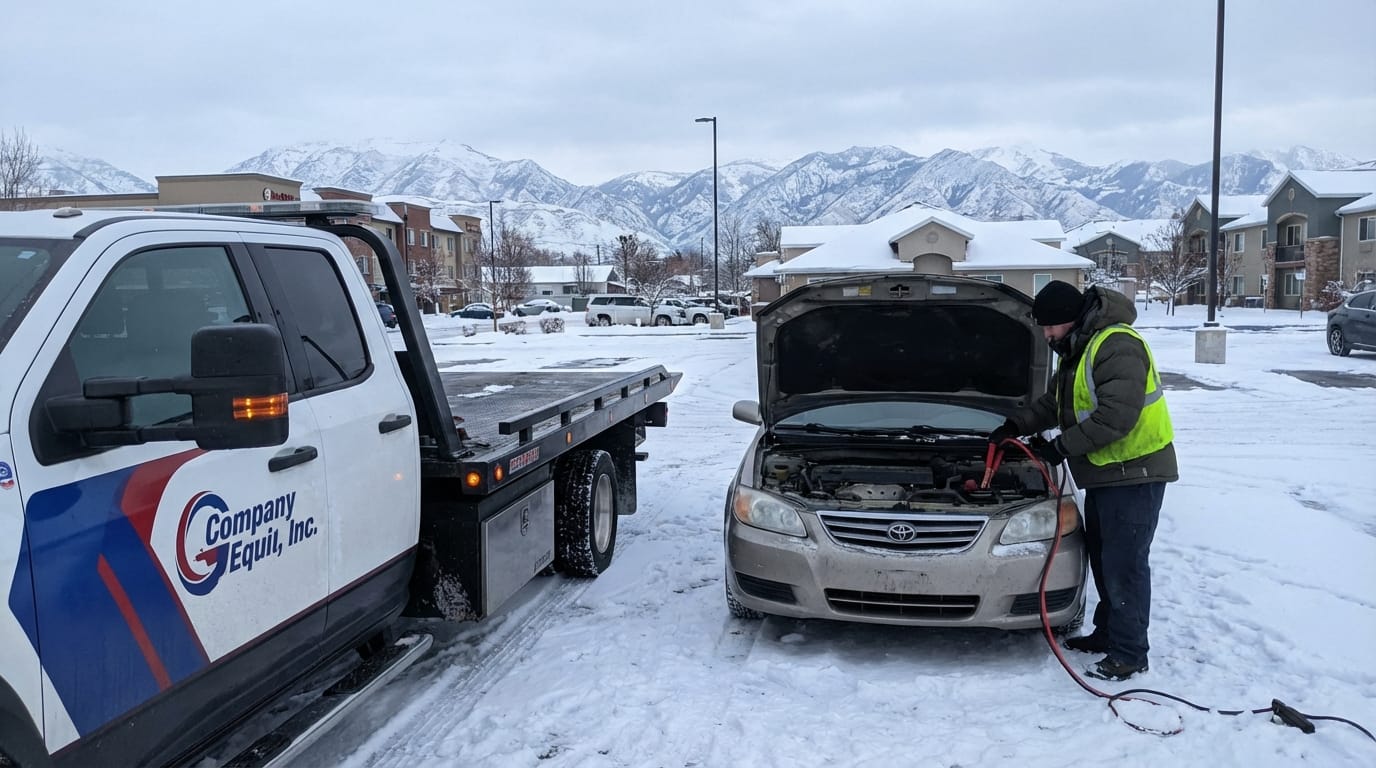
A silent engine on a freezing December morning in the Wasatch Front is more than an inconvenience; it is a mechanical failure driven by chemistry and altitude. When you turn the key and hear nothing, our jump start service delivers the precise, surge-protected power transfer required to revive your vehicle without damaging sensitive onboard computers.
The Physics of Battery Failure in Salt Lake City
Salt Lake City presents a unique, hostile environment for automotive batteries. Most drivers assume cold weather is the sole culprit behind a dead battery, but the reality is a two-part process described by automotive engineers as “Summer Cook, Winter Kill.” The intense heat of Utah summers—often exceeding 100°F—causes the electrolyte solution inside a standard flooded lead-acid battery to evaporate and the internal lead plates to corrode. This degradation reduces the battery’s overall capacity, yet the warm weather allows the chemical reaction to remain active enough to start the engine.
When December arrives and temperatures drop below freezing, the chemical reaction slows drastically. At 32°F, a fully charged battery loses roughly 35% of its strength. By 0°F, it loses 60%. Simultaneously, the engine oil thickens, requiring significantly more amperage to crank the internal components. The battery, weakened by the summer heat, now faces its highest demand when it is least capable of delivering power. This is not bad luck; it is a predictable thermodynamic event common in high-altitude desert climates.
Defining the service requires understanding the difference between “boosting” and “jump starting.” A boost implies a slight assist to a weak battery. A professional jump start involves supplying the entire electrical load required to cycle the starter motor and engage the fuel injectors, often bypassing the internal resistance of a frozen or sulfated battery. We utilize industrial-grade equipment capable of delivering consistent voltage, which is critical for modern vehicles equipped with complex Electronic Control Units (ECUs).
Battery Efficiency Data and Cold Weather Strategy
Understanding the correlation between ambient temperature and available cranking power helps explain why our call volume spikes during the first hard freeze of the year. The following data illustrates the inverse relationship between engine load and battery output as temperatures plummet in the Salt Lake Valley.
| Temperature (Fahrenheit) | Battery Output Efficiency | Engine Cranking Load Increase | Risk of Electrolyte Freezing (Discharged) |
|---|---|---|---|
| 80°F | 100% | 0% (Baseline) | Near Zero |
| 32°F | 65% | +55% | Low |
| 0°F | 40% | +210% | Moderate |
| -20°F | 18% | +300% | High |
Strategic Response to Voltage Drop When a battery creates a “no-start” condition, the voltage has often dropped below the threshold required to keep the fuel pump and ignition system synchronized.
- Voltage Stabilization: We do not simply hook up cables and rev the engine. Our technicians verify the resting voltage of the battery. If it reads below 10.5 volts, there is a risk of a dead cell. Forcing high amperage into a battery with a shorted cell can cause overheating or explosion [1].
- The Parasitic Drain Factor: Modern vehicles are never truly “off.” Anti-theft systems, keyless entry receivers, and telematics modules draw power 24/7. In Salt Lake City, where vehicles may sit parked at the airport or trailheads for days in the cold, this parasitic draw depletes the reserve capacity.
- Alternator Verification: A jump start gets the engine running, but the alternator must keep it running. Once started, we quickly assess if the alternator is outputting the required 13.5 to 14.5 volts. If the alternator has failed, a jump start is only a temporary fix that will leave you stranded again miles down I-15.
Professional Methodology: Beyond Jumper Cables
The image of two cars nose-to-nose with a pair of rusty cables is a relic of the analog era. Attempting this on a 2025 vehicle risks catastrophic damage to the electrical system. A sudden voltage spike—known as a “load dump”—can occur if clamps are removed incorrectly, potentially frying the Body Control Module (BCM) or the infotainment system.
- Site Assessment and Safety Check:
Before any equipment is connected, we inspect the battery for physical bloating or leakage. A frozen battery (where the electrolyte has turned to ice) must never be jumped. Passing current through ice causes rapid expansion and can rupture the casing, spraying sulfuric acid. We also check for the smell of rotten eggs (hydrogen sulfide), indicating a dangerous off-gassing event.
- Terminal Cleaning and Connection:
Corrosion acts as an insulator. We use wire brushes to expose clean lead on the terminals. We connect our commercial jump packs using the “Positive-First, Negative-Last” protocol. Crucially, the negative clamp is attached to a chassis ground point away from the battery to prevent sparks near any venting hydrogen gas.
- Smart Power Delivery:
Unlike another vehicle’s alternator, which fluctuates, our jump packs deliver a regulated flow of DC current. This protects the sensitive 5-volt reference sensors found in modern engines.
- The “Crank” Protocol:
We instruct the driver to attempt to start the vehicle in short 3-5 second bursts. Extended cranking overheats the starter motor, which is already under immense stress turning a cold engine. If the car does not start after three attempts, we pivot to diagnosing other potential issues like fuel delivery freezing or ignition failure.
- Post-Start Integration:
Once the engine fires, we do not immediately disconnect. We allow the vehicle’s alternator to stabilize the system voltage for 60 seconds. We then remove the clamps in reverse order (Negative first, Positive last) to minimize the risk of an arc.
The Hybrid and EV Misconception
A common myth among Salt Lake City drivers is that hybrid and electric vehicles (EVs) are immune to jump start needs. This is false. While the high-voltage (HV) battery powers the wheels, a standard 12-volt lead-acid or lithium auxiliary battery powers the computers, lights, and—most importantly—the “contactors” that connect the high-voltage battery to the motor.
If the 12-volt battery dies, the EV cannot start, even if the main battery is 100% charged. You cannot drive.
- EV Jump Start Specifics: Jumping an EV requires strict adherence to manufacturer guidelines. The 12-volt terminals are often buried under plastic cowlings or located in the “frunk” (front trunk).
- Low Voltage Sensitivity: EV electronics are incredibly sensitive. Using a massive diesel truck to jump a small EV 12-volt system can overwhelm the DC-DC converter. We use specialized low-amperage settings to wake up the EV’s computer without shocking the system [2].
- Regenerative Braking Limitations: After a jump start, an EV’s regenerative braking might be temporarily limited until the 12-volt battery recharges and the system recalibrates. We advise drivers of this handling change immediately.
Nuance, Counter-Arguments, and Risks
“I have a portable lithium jump pack in my trunk; I don’t need a service.” Portable jump starters are popular, but they have a fatal flaw in Utah winters: lithium-ion chemistry struggles in extreme cold. If you leave the jump pack in your trunk overnight in 10°F weather, its internal resistance rises, and its output drops. Often, when you need it most, the pack itself is too cold to deliver the necessary peak amperage to turn over a frozen V8 engine. Furthermore, inexpensive consumer units often lack reverse-polarity protection. One mistake in the dark can melt the wiring harness.
“I’ll just ask a stranger for a jump.” This is the “Good Samaritan” risk. Modern vehicles have “smart alternators” that vary output based on load. Connecting a dead car to a running modern car can confuse the donor car’s voltage regulator, leading to check engine lights or blown fuses on the donor vehicle. By calling a professional service, you isolate the risk. We use independent power sources, ensuring no damage comes to a third-party vehicle.
“It’s just a battery; how hard can it be?” The complexity lies in the placement. Many modern vehicles (Jeeps, BMWs, Dodges) place batteries under the passenger seat, in the wheel well, or in the trunk. These require accessing remote terminals under the hood. Misidentifying a transmission control module ground for a negative terminal is a common, expensive error made by untrained individuals.
Future Outlook: The Death of the 12V Lead-Acid?
As we look toward 2026 and beyond, the automotive industry is slowly shifting away from the heavy, toxic lead-acid battery. Tesla has already begun moving to 16-volt lithium-ion low-voltage batteries, and other manufacturers are following suit with 48-volt architectures.
- Implications for Towing: These new systems require different voltages for jump starting. Using a standard 12V jump pack on a 48V system will do nothing; using a 24V truck setting on a 16V lithium system will destroy it.
- Telematics and Prediction: We anticipate a future where vehicles self-diagnose battery health and alert the driver—or a service provider like us—before the failure occurs. Until then, reactionary service remains vital.
- Solid-State Technology: While solid-state batteries promise better cold-weather performance for EVs, the legacy fleet of gas and standard hybrid cars in Salt Lake City will rely on lead-acid chemistry for decades. The need for thermal-aware jump start procedures will not disappear.
Winter Preparedness and Service Execution
We operate under the assumption that every jump start call in December is an emergency. A driver stranded in a cold car faces hypothermia risks within hours if not properly dressed. Speed is our metric of success.
Why Professional Intervention Wins:
- Safety: We carry high-vis gear and traffic control lighting, keeping you safe on the shoulder of I-15 or I-80.
- Diagnostics: We don’t just jump; we advise. If your battery is 5 years old and bulging, we will tell you it needs replacement immediately, preventing a second breakdown tomorrow.
- Access: We have lockout tools. It is common for a dead battery to disable the electronic locks, trapping the jumper cables (or the driver) outside the vehicle. We can solve the car lockout and the dead battery in one visit.
If you turn the key and hear silence, do not rely on frozen consumer gadgets or the goodwill of strangers with questionable equipment. Secure your vehicle’s electronics and your personal safety.
For immediate dispatch in the Salt Lake City metro area, contact us. We handle everything from sedan battery failures to heavy-duty diesel startups.
Call Salt Lake Towing: 801-701-1233 Visit us online: Salt Lake Towing