
Winter in Utah often brings unpredictable road conditions that can leave even the most experienced drivers stranded in deep snowbanks, icy ditches, or slick mud. When traction fails and your wheels simply spin without gaining ground, professional recovery becomes necessary to retrieve your automobile without causing further damage.
Learning how a proper winch out service works ensures you remain safe while experts handle the complex recovery of your stuck vehicle.
Key Takeaways
-
Distinction from Towing: Winch outs are specialized recovery services designed to pull vehicles out of precarious situations like ditches, mud, or snow, rather than just transporting them.
-
Safety Hazards: Attempting to free a vehicle without proper equipment can result in snapped cables, frame damage, or severe personal injury.
-
Local Terrain: Salt Lake City’s unique geography, including steep foothills and canyon roads, requires specific recovery techniques during winter months.
-
Professional Assessment: A successful recovery requires calculating the vehicle’s weight, the resistance of the terrain, and identifying safe anchor points.
Understanding Winch Out Services
Many drivers assume that all roadside assistance calls are the same, but there is a significant technical difference between a standard tow and a recovery operation. A standard tow usually implies that the vehicle is on a relatively flat, accessible surface and simply needs to be hooked up and moved. However, when a vehicle has slid off the roadway, is stuck in a snow berm, or has bottomed out in mud, standard hook-up procedures are insufficient.
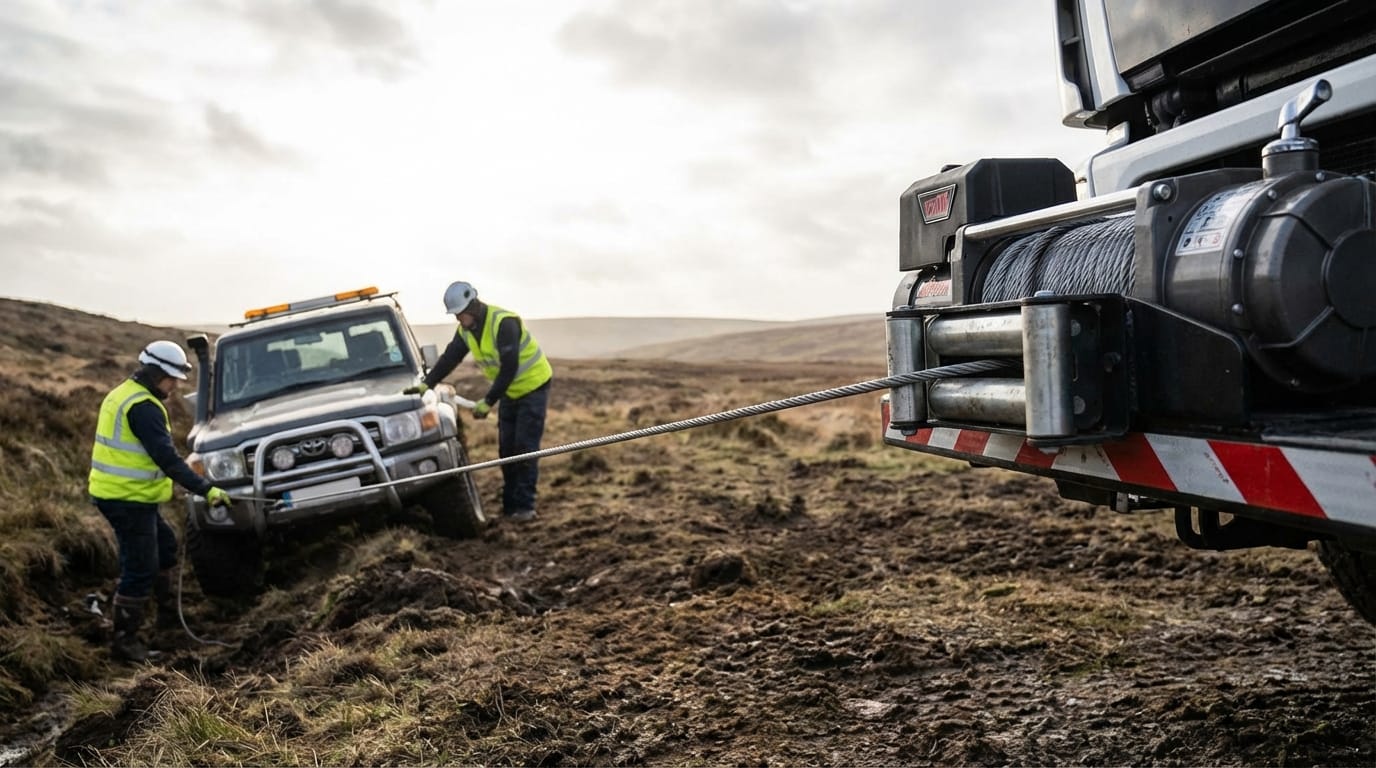
This is where winching comes into play. A winch out involves using a heavy-duty motorized cable and drum system to pull a vehicle from a precarious position back onto a solid, drivable surface. This service is essential when the vehicle is immobilized not by mechanical failure, but by the environment. For residents in Salt Lake City, specialized winching services for immobilized vehicles are often the only solution when winter storms render driveways and shoulders impassable.
The physics involved in winching are complex. It is not merely about pulling hard; it is about applying steady, controlled force while accounting for the resistance of the mud or snow and the gross vehicle weight rating (GVWR) of the car. Professional operators are trained to calculate these factors to ensure the vehicle is recovered without tearing off a bumper or damaging the suspension alignment.
Common Scenarios Requiring Winch Outs in Salt Lake City
Living in the Wasatch Front presents a unique set of driving challenges. While our mountains provide world-class recreation, they also create hazardous driving conditions that frequently necessitate professional recovery services.
The Winter Trap: Snow and Ice
January in Utah is notorious for “black ice” and sudden accumulation. A common scenario involves a commuter sliding off I-15 or I-80 into the median. Even if the car is undamaged, the lack of traction makes it impossible to return to the pavement. Similarly, unplowed side streets in the Avenues or steep driveways in Cottonwood Heights can trap vehicles. Once the tires lose contact with the asphalt and are spinning on packed snow, momentum is lost, and the vehicle becomes dead weight.
It is important to recognize that spinning your tires in these situations often makes the problem worse. The friction creates a layer of ice under the tire, polishing the surface and removing any hope of traction. Furthermore, high-speed spinning can overheat your transmission.
Mud and Soft Shoulders
During the freeze-thaw cycles common in late winter and early spring, the ground alongside roads can become deceptively soft. Drivers who pull onto the shoulder to check a map or take a call may find their vehicle sinking into the mud. This is particularly common for delivery fleets and construction vehicles visiting new job sites where pavement hasn’t been laid yet. A heavy truck can sink to its axles in minutes, requiring a heavy-duty winch out to break the suction of the mud.
Off-Road Misadventures
Utah’s outdoor culture means many residents own SUVs and trucks equipped for adventure. However, even the most capable 4×4 can get high-centered on a rock or stuck in a deep rut in the canyons. While we always advocate for safe driving, we understand that exploration sometimes leads to immobilization. Understanding the hidden dangers of driving on icy or unpaved roads can help you avoid these situations, but when they occur, professional recovery is the safest route home.
The Dangers of DIY Recovery Attempts
When a vehicle gets stuck, the immediate instinct for many drivers is to accept help from a passing Good Samaritan with a pickup truck and a tow strap. While the intention is noble, the risks associated with amateur recovery are astronomical. Without professional training and graded equipment, “yanking” a stuck car can lead to catastrophic failure.
“The kinetic energy stored in a stretched tow strap is immense. If a strap or attachment point breaks, the recoil can send metal hooks flying at lethal speeds.”
Modern vehicles are equipped with plastic bumpers and complex crumple zones. Attaching a strap to a suspension component or a non-structural part of the frame can tear the vehicle apart. We have seen instances where a helpful bystander ripped the entire front bumper and radiator support off a stuck sedan because they attached the strap to the wrong point. Furthermore, most consumer-grade straps are not rated for the ‘shock load’ that occurs when a vehicle is jerked out of a ditch.
Professional tow operators use specialized equipment that allows for a slow, steady pull. They understand vector forces and will use snatch blocks (pulleys) to change the direction of the pull or increase the mechanical advantage, ensuring the vehicle moves smoothly rather than violently.
The Professional Winch Out Process
When you call Salt Lake Towing for a winch out, you are paying for expertise and a systematic approach to safety. Here is what you can expect during a professional recovery operation:
1. Site Assessment
Upon arrival, the operator evaluates the scene. They check for hazards like oncoming traffic, unstable ground, or overhead power lines. They assess how deeply the vehicle is buried and identifying the underlying surface (ice, mud, gravel).
2. Calculating Resistance
The operator estimates the “mire resistance.” A car buried to its wheels in mud requires significantly more force to move than a car sitting on top of ice. This calculation determines whether a single line pull is sufficient or if complex rigging with state-of-the-art towing tools and snatch blocks is required to multiply the pulling force.
3. Securing Anchor Points
The tow truck must be stabilized to prevent it from sliding toward the stuck vehicle. The operator will engage the truck’s wheel lift or specialized stabilizers (spades) into the ground. They then locate the manufacturer-specified recovery points on your vehicle. If these are inaccessible, they use soft straps and bridles to attach to the frame safely, avoiding damage to tie rods or control arms.
4. The Extraction
The operator controls the winch remotely, standing at a safe distance while monitoring the cable tension. They may ask you to gently steer the vehicle to align the wheels with the direction of the pull, but often, the winch does all the work. The goal is a controlled, slow movement until the drive wheels regain traction on solid ground.
What to Do While Waiting for Help
If you find yourself stranded in Salt Lake City or the surrounding areas, your actions while waiting for the recovery team are critical for your safety.
-
Assess Your Safety: If you are stuck on a busy highway like I-15, stay inside your vehicle with your seatbelt on. It is safer to be inside a steel cage than standing exposed on the roadside where other cars might lose control.
-
Make Yourself Visible: Turn on your hazard lights immediately. If you have emergency triangles or flares and it is safe to deploy them, do so to warn approaching traffic.
-
Clear the Tailpipe: If you are stuck in deep snow, ensure your exhaust pipe is not obstructed. A blocked tailpipe can force carbon monoxide back into the cabin, which can be fatal. Crack a window slightly for fresh air.
-
Do Not Over-Spin Tires: As mentioned earlier, spinning tires creates ice and digs the vehicle deeper, making the eventual winch out more difficult and potentially more expensive.
-
Prepare for the Operator: If possible, locate your vehicle’s owner’s manual to find the tow eyelet (often found in the trunk with the spare tire) and have it ready. This screw-in eyelet is the safest point for winching many modern European and Asian vehicles.
Choosing the Right Recovery Partner
For business owners with fleets or parents with young drivers, having a reliable towing partner is a crucial part of risk management. Not all towing companies are equipped for heavy-duty recovery or complex winch outs. When selecting a service, look for a provider with a diverse fleet that includes flatbeds and wreckers with boom capabilities.
Price is always a factor, but the cost of a professional winch out is significantly lower than the repair bill for a suspension torn out by an amateur attempt. Transparency is key. A reputable company will ask detailed questions about your situation—location, distance from the road, condition of the terrain—to provide an accurate ETA and ensure they dispatch the right equipment for the job.
Frequently Asked Questions
What is the difference between a tow and a winch out?
A tow involves transporting a vehicle from one location to another (e.g., from the roadside to a mechanic). A winch out is a recovery service used to pull a vehicle out of a stuck position (mud, snow, ditch) so it can be driven again or towed if necessary. If your car works but is simply stuck, you need a winch out.
Will winching damage my car?
When performed by professionals using the correct anchor points and tension, winching is safe. Damage usually occurs during DIY attempts when chains are attached to suspension components or when the angle of the pull forces the bodywork against the ground.
Can you winch a car out of a deep ditch?
Yes, but this often requires a boom lift or a rotator truck depending on the angle and depth of the ditch. It is vital to describe the depth and angle of the ditch when you call for service so the correct truck is dispatched.
Does my insurance cover winch out services?
Many insurance policies with “Roadside Assistance” coverage include winching services, often up to a certain distance from the road (e.g., 50 or 100 feet). Check with your provider. We can provide the necessary invoices for you to submit for reimbursement.
What if my car is 4-wheel drive?
Even 4-wheel drive vehicles get stuck when all four wheels lose traction or the vehicle high-centers on snow. In fact, 4WD vehicles often get stuck further off the road than 2WD vehicles, sometimes requiring more complex recovery rigging.
Conclusion
Getting stuck in the snow or mud is a frustrating and potentially dangerous experience, but it doesn’t have to ruin your day or your vehicle. Understanding the mechanics of a safe winch out and resisting the urge to handle it yourself are the best ways to ensure a quick resolution. Whether you are a daily commuter on I-15 or a business owner managing a fleet, knowing who to call when traction fails provides invaluable peace of mind.
If you find yourself stuck in Salt Lake City or the surrounding areas, do not risk your safety or your vehicle’s integrity. Contact Salt Lake Towing for immediate, professional assistance. You can reach our 24-hour dispatch team directly at 801-701-1233 to get back on the road safely.