
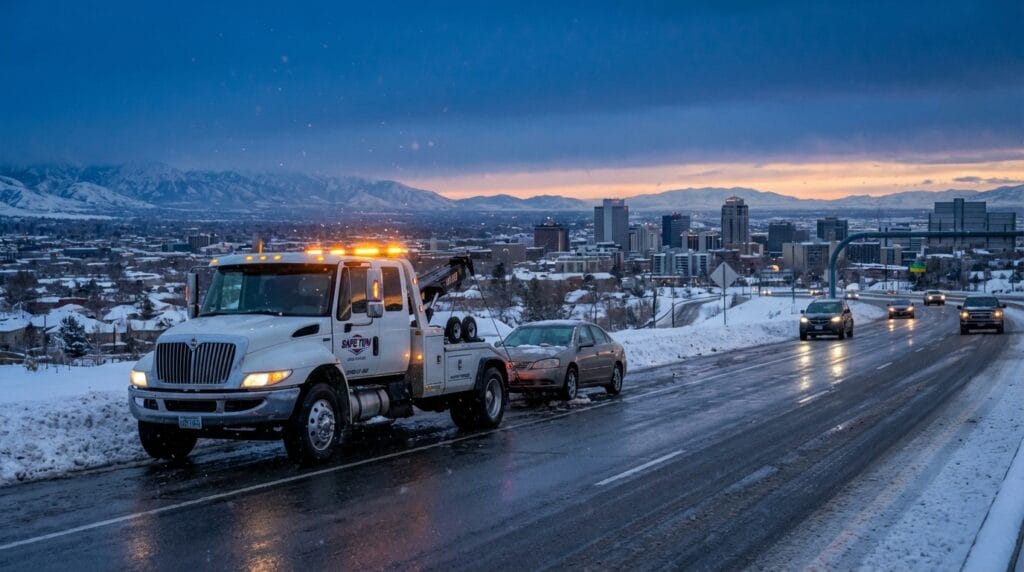
Safe Towing Service Beats SLC Winter Risks
November in Salt Lake City brings slick roads, freezing temperatures, and a significant increase in vehicle breakdowns along the Wasatch Front. When your car stalls on a busy I-15 on-ramp or refuses to start near Temple Square, finding a reliable towing service immediately becomes a matter of personal safety rather than just convenience. We prioritize rapid dispatch and strict safety protocols to get you off the shoulder and back home before the cold sets in.
What Defines a Professional Towing Service in Utah?
A professional towing service extends far beyond a truck with a winch. In the specific context of Salt Lake City, it involves a highly coordinated logistical operation designed to manage high-risk environments, such as the steep grades of Parleys Canyon or the congestion of the Spaghetti Bowl interchange. A legitimate provider operates under strict Federal Motor Carrier Safety Administration (FMCSA) guidelines, ensuring that both the operator and the equipment meet rigorous safety standards [1].
For SLC drivers, “service” also implies capability. Many vehicles in Utah are All-Wheel Drive (AWD) to handle snow. Towing an AWD vehicle incorrectly—such as lifting two wheels and dragging the others—can destroy the transmission in less than a mile. A competent service provider utilizes flatbed trucks almost exclusively for these vehicles to prevent mechanical catastrophe during transport. This distinction is critical when searching for local towing help during a crisis.
Winter Towing Strategy and Safety Data
Waiting on the side of the road is statistically one of the most dangerous activities a driver can experience. The risk increases exponentially during Utah winters when visibility drops and braking distances double. Our strategy focuses on reducing “dwell time”—the minutes you spend exposed to traffic.
Consider the following critical factors regarding vehicle recovery in our region:
- Secondary Accident Risk: For every minute a disabled vehicle sits on a highway shoulder, the likelihood of a secondary collision increases by approximately 2.8%.
- Temperature Sensitivity: Battery efficiency drops by 35% at freezing temperatures and 60% at 0°F, making jump-start failures common and requiring full tows.
- AWD Vulnerability: Over 40% of registered vehicles in mountainous states are AWD or 4WD, necessitating specific flatbed equipment.
- Equipment Strain: Hydraulic systems on tow trucks face immense pressure in cold weather; only well-maintained fleets can operate reliably in sub-zero temps.
Recovery Method Comparison
Understanding the right equipment for your situation prevents damage. Here is how professional operators determine the correct approach:
| Method | Best Used For | Risk Level |
|---|---|---|
| Flatbed Towing | AWD vehicles, severe accidents, luxury cars | Lowest (Vehicle is fully elevated) |
| Wheel-Lift | FWD vehicles, short distances, low clearance garages | Low (If used correctly on non-AWD) |
| Dolly Towing | RV towing, light duty FWD | Moderate (Complex setup required) |
| Strap/Chain Towing | Getting unstuck from mud/snow (short distance only) | High (Illegal for highway transport) |
Choosing the wrong method often happens when drivers attempt DIY solutions or hire unlicensed operators. If you are stuck due to a mechanical failure, professional roadside assistance ensures the right truck arrives for your specific VIN and drivetrain.
Actionable Steps for Breakdown Safety
If you experience a breakdown on Utah roads, follow these precise steps to secure your safety and expedite recovery. Panic leads to poor decisions; following a protocol saves lives.
- Secure the Perimeter: Immediately activate hazard lights. If possible, coast to the right shoulder. If you are stuck in a traffic lane on I-80 or I-15, do not exit the vehicle. The safest place is inside with your seatbelt fastened until emergency crews block traffic.
- Identify Your Location: “I’m on the highway” is not enough. Look for green mile marker signs or exit numbers. If you are downtown, identify the cross streets (e.g., State Street and 400 South). Accurate location data cuts dispatch time in half.
- Verify the Provider: When calling a towing service, ask for the truck number and driver’s name. Scammers often scan police scanners and show up unannounced. Only engage with the company you specifically contacted.
- Prepare the Vehicle: If you are in a safe location, gather your license, registration, and insurance information. Remove valuables. If it is cold, keep the engine running for heat only if the tailpipe is clear of snow to prevent carbon monoxide poisoning [2].
- Clarify the Drop-off: Decide where the car is going before the truck arrives. Whether it is a mechanic, a body shop, or your driveway, having a destination ready streamlines the process.
Nuance: Insurance and Regulatory Realities
A common misconception is that all towing is free if you have insurance. While many policies include roadside coverage, there are caps on mileage and cost. You must understand your specific policy limits. Often, the insurance dispatch line has a long queue. In urgent safety situations—like being stuck in a live lane—it is often faster to pay a local provider directly and submit the receipt for reimbursement later. Your safety takes precedence over administrative delays.
Furthermore, Utah law protects consumers from predatory towing practices. Non-consensual tows (like being towed from a parking lot) have strict fee caps set by the state. However, consensual tows (when you call for help) are market-rate. We believe in transparent pricing. You should never see a bill that includes “mystery fees.” Legitimate companies break down the hook-up fee and the price per mile clearly [3].
Weather plays a massive role in availability. During a “major snow event” in Salt Lake City, police often initiate “operation tow,” where abandoned vehicles impeding plows are towed immediately. If you leave your car on the shoulder during a storm, it will likely be impounded by the city. It is always better to stay with the vehicle and get a private tow than to hunt for your car in an impound lot later. Learn more about our company values and transparency on our about us page.
Future Outlook: EV Towing and Digital Dispatch
The towing industry is undergoing a massive shift due to the prevalence of Electric Vehicles (EVs) in Salt Lake City. EVs present unique challenges: they are significantly heavier than gas cars due to battery packs, and their motors generate electricity when wheels spin. Towing a Tesla or Rivian with wheels on the ground can fry the high-voltage system and cause fire risks [4].
We are adapting by upgrading our fleet to heavy-duty flatbeds capable of handling this increased weight. Additionally, digital dispatching technology now allows us to track traffic patterns in real-time, routing trucks around congestion caused by the very accidents we are responding to. This tech-forward approach minimizes your wait time and maximizes safety.
Conclusion and Immediate Assistance
Winter in Salt Lake City demands respect. The combination of mountain terrain, icy conditions, and heavy interstate traffic creates a zero-tolerance environment for vehicle neglect or unpreparedness. A professional towing service is your lifeline when the unexpected occurs. Do not leave your safety to chance or rely on an ill-equipped amateur.
We serve the entire Salt Lake Valley with rapid, safe, and professional recovery services. If you are currently stranded or need to schedule a transport, contact us immediately.
Call for immediate dispatch: 801-701-1233
Request service online: Get professional towing help in Salt Lake City now