
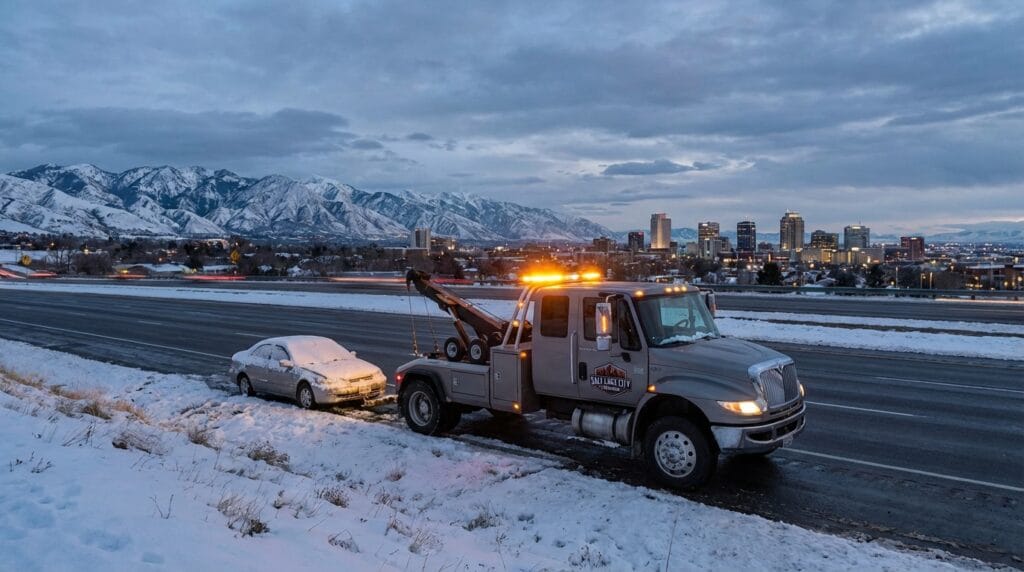
Salt Lake City Accident Recovery: Critical Winter Crash Steps
The sound of crunching metal on I-15 is a noise you never forget. One moment you are merging near the Spaghetti Bowl; the next, you are staring at an airbag, wondering how to get your vehicle off the freeway before another car loses traction. Accident recovery in Salt Lake City is not just about moving a car—it is a complex operation involving physics, safety protocols, and rapid scene clearance to prevent secondary collisions.
What Is Accident Recovery? (It’s Not Just Towing)
Most drivers use the terms “towing” and “recovery” interchangeably. In our industry, they represent two entirely different skill sets. Towing is the transport of a disabled vehicle—think of a sedan with a dead battery in a flat driveway. Recovery is the science of extracting a vehicle that has left the roadway, overturned, or sustained heavy structural damage.
In Salt Lake City, the geography dictates the difficulty. A slide-off in Parley’s Canyon isn’t a simple hook-up; it requires calculating resistance, angle, and working load limits to winch a vehicle up a snowy embankment without snapping cables or causing further damage. If your vehicle is on its roof, wedged against a Jersey barrier, or stuck in deep mud near the Great Salt Lake, you don’t need a tow truck—you need a recovery specialist.
The “Stuck” Spectrum
Recovery operations are categorized by the level of resistance and the equipment required. A “winch-out” might only require one cable and a stable anchor. A “rollover” requires stabilization struts, snatch blocks to redirect force, and often a rotator truck (a crane-like wrecker) to lift and pivot the vehicle back onto its wheels.
Strategy & Data: The Reality of SLC Winter Roads
Winter in Utah changes the physics of driving. According to preliminary 2024 data from UDOT and the Department of Public Safety, Utah roads saw 281 fatalities last year [1]. While summer sees higher speeds and more fatalities, winter months bring a higher volume of crashes due to road surface conditions.
The danger zone is often “black ice”—specifically on overpasses and bridges where the road surface freezes faster than the ground. In 2024, winter storms contributed to hundreds of slide-offs along the Wasatch Front. When you call us for roadside assistance during a storm, we triage calls based on immediate danger. A car blocking a live lane on I-80 takes precedence over a vehicle safely in a ditch.
Accident Recovery vs. Standard Towing
| Feature | Standard Towing | Accident Recovery |
|---|---|---|
| Vehicle Status | Drivable or accessible (e.g., breakdown) | Immobile, overturned, or off-road |
| Equipment | Flatbed or Wheel-lift | Rotators, Winches, Snatch Blocks, Air Cushions |
| Operator Skill | Load and secure | Rigging physics, hazmat awareness, traffic control |
| Scene Safety | Low risk (parking lot/shoulder) | High risk (live traffic, leaking fluids, unstable ground) |
Actionable Steps: Managing the Crash Scene
If you are involved in a collision in Salt Lake County, your adrenaline will spike. Follow this methodology to ensure safety and streamline your recovery.
- Assess and Evacuate (If Safe): If your car is drivable and no one is injured, Utah law requires you to move to the nearest shoulder or exit. If you cannot move, stay buckled inside. Standing on the freeway shoulder is lethal in icy conditions.
- Call 911: Report injuries and road blockage. If police respond, they may initiate a “non-consent” tow to clear the road immediately.
- Document the Scene: If safe, take photos of the vehicle position and damage *before* the recovery team moves it. This is crucial for insurance.
- Request a Specialist: When you call towing services, be specific. Tell the dispatcher: “My car is 20 feet down an embankment,” or “My car is on its side.” This ensures we send the right truck (like a wrecker with a boom) rather than a standard flatbed that cannot reach you.
- Verify the Tower: Scams exist. Ensure the truck that arrives has the company name you called. In Utah, you have the right to know the rates and see a fee schedule.
Nuance: The “Consent” vs. “Non-Consent” Tow
This is the most misunderstood aspect of accident recovery. Who decides which tow truck shows up?
Non-Consent Tows (Police Rotation): If you are incapacitated, or if your vehicle is blocking a major artery like I-15 during rush hour, the Utah Highway Patrol (UHP) or SLCPD will call the next available company on their rotation list. You do not get to choose in this scenario because speed is safety. These tows are heavily regulated by the state, with caps on rates and storage fees [2].
Consent Tows (Owner Request): If you are safe, the vehicle is not an immediate hazard, and you are present, you have the right to call your preferred provider. This is often cheaper and allows you to direct the vehicle to your mechanic of choice rather than an impound lot. If an officer tries to force a rotation tow when you have your own truck en route (and you are not blocking traffic), you can politely assert your right to use your own service.
Insurance Coverage: Many drivers assume “full coverage” pays for recovery. It usually does, but “winch-outs” or complex recoveries can sometimes exceed standard towing caps. Check your policy for “on-scene labor” coverage.
Future Outlook: The EV Recovery Challenge
The rise of Electric Vehicles (EVs) in Utah—driven by tax incentives and our tech sector—has introduced a new variable to accident recovery: Thermal Runaway.
When a gas car crashes, we clean up fuel spills. When an EV crashes, the damage to the lithium-ion battery pack can cause a fire that is incredibly difficult to extinguish. Worse, a damaged battery can re-ignite hours or days later [3].
Recovering a Tesla or Rivian requires different protocols. We cannot simply drag it; the regenerative braking motors can generate electricity and fry the electronics if the wheels spin. We must use dollies or flatbeds exclusively. Furthermore, if the battery is compromised, the vehicle may need to be quarantined at the yard, parked away from other cars and buildings to prevent a yard fire. As EV adoption grows in SLC, we are upgrading our fleet with specific equipment to handle these heavier, high-voltage risks safely.
Conclusion & Next Steps
Winter accidents in Salt Lake City are often sudden and violent. Whether you slide into a guardrail on the Bangerter Highway or get stuck in deep snow up Big Cottonwood Canyon, the difference between a nightmare and a solution is the skill of your recovery team.
Do not settle for a provider who just drags your car. You need a team that understands load limits, leverage, and scene safety. We have the heavy-duty wreckers and the trained operators to handle complex recoveries without adding damage to your vehicle.
Save our number before the snow falls. If you find yourself off the road, call us immediately. We will get you back on solid ground.
Call for Immediate Dispatch: 801-701-1233
Learn More About Our Team: About Salt Lake Towing