
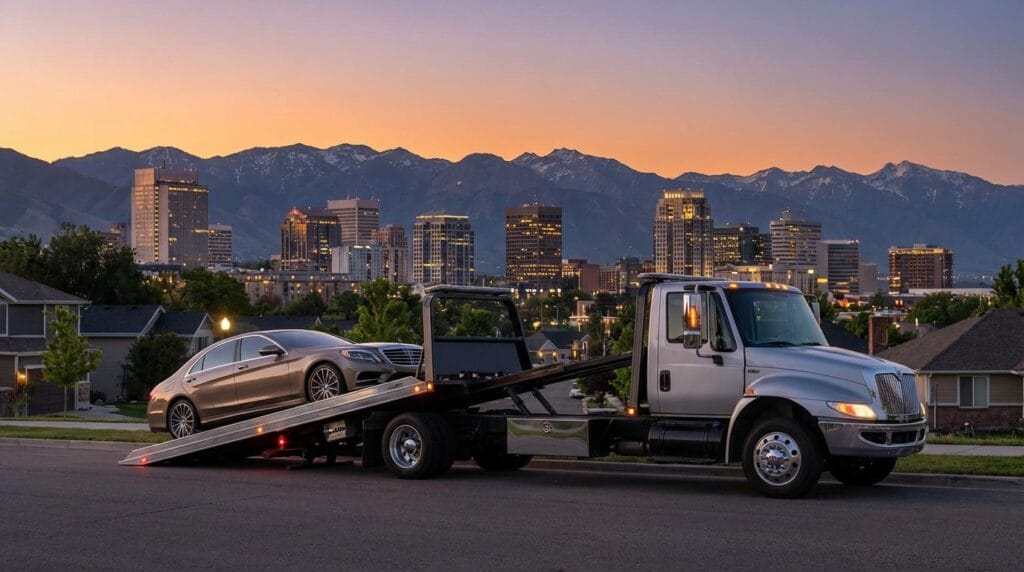
SLC Flatbed Towing: Damage-Free Moves
When your specialty vehicle, all-wheel drive SUV, or luxury car needs a lift, not just any tow will do; you need the absolute security that only flatbed towing provides. We ensure your vehicle arrives in the exact condition it was picked up in, eliminating the risks associated with traditional towing methods across Salt Lake City.
What is Flatbed Towing?
Flatbed towing is a method of vehicle transportation where the entire vehicle is placed on a flat, level platform on the back of a tow truck. Unlike traditional hook-and-chain or wheel-lift towing, which hoists one end of the vehicle and drags it on its remaining tires, our flatbed trucks carry your vehicle completely off the ground. This method is the gold standard for vehicle safety during transport.
Here in Salt Lake City, UT, this service is not a luxury—it’s often a necessity. With our varied terrain, from the steep inclines of the Wasatch Front to the unpredictable winter road conditions, flatbed towing offers unmatched stability and protection. It’s the ideal solution for all-wheel-drive (AWD) vehicles, exotic cars, classic automobiles, and vehicles damaged in an accident where further wheel rotation could cause more harm.
The process involves a hydraulic system that tilts the bed downwards, allowing it to function as a ramp. The vehicle is then driven or winched onto the platform. Once securely in place, the bed is leveled, and the vehicle is meticulously strapped down at all four corners, ensuring zero movement during transit.
Why Flatbed Towing is Essential in Salt Lake City
Choosing the right towing method in Salt Lake County can mean the difference between a simple recovery and a costly repair bill. The unique demands of our environment and the types of vehicles common here make flatbed towing the superior choice. It mitigates risks that other methods simply can’t avoid.
Here’s a breakdown of why it’s the safest bet for your vehicle:
- Protection for All-Wheel Drive (AWD) & 4×4 Systems: Towing an AWD or 4×4 vehicle with its wheels on the ground can cause severe damage to the drivetrain and transmission. A flatbed truck carries the vehicle, completely disengaging the wheels and protecting these complex systems.
- Ideal for Low-Clearance Vehicles: Sports cars, luxury sedans, and modified vehicles sit low to the ground. A flatbed’s tilt-tray design allows for a gentle loading angle, preventing damage to bumpers, spoilers, and the undercarriage that hook-and-chain methods often cause.
- Eliminates Wear and Tear: Your vehicle’s tires, suspension, and alignment are not subjected to the stress of being dragged on the road. This means no unnecessary mileage is added and no risk of tire blowouts or alignment issues caused by the tow itself.
- Enhanced Safety for Accident Recovery: After a collision, a vehicle may have unseen damage to its axles, wheels, or frame. Placing it on a flatbed prevents exacerbating this damage, which is a significant risk when dragging a vehicle from an accident scene.
- Versatility for More Than Just Cars: Our flatbed trucks in Salt Lake City can transport more than just standard cars. We can safely move motorcycles, small construction equipment, classic cars, and even large tool sheds.
The data clearly shows the advantages of this method, especially concerning vehicle system protection. A report from the American Automobile Association (AAA) highlights that improper towing is a leading cause of preventable transmission damage in modern vehicles. Flatbed towing neutralizes this risk entirely.
| Feature | Flatbed Towing (Our Method) | Dolly / Wheel-Lift Towing | Hook & Chain Towing (Outdated) |
|---|---|---|---|
| Vehicle Contact | Tires are secured to a platform; no road contact. | Two wheels remain on the road surface. | Frame/axle is pulled; two wheels on the road. |
| AWD/4×4 Safety | Excellent. No risk to the drivetrain. | Risky. Can damage the transmission/drivetrain. | Extremely Risky. High probability of damage. |
| Low-Clearance Safety | Excellent. Gentle loading angle protects bumpers. | Poor. High risk of scraping and undercarriage damage. | Very Poor. Often causes significant cosmetic damage. |
| Post-Accident Use | Ideal. Prevents further damage to a compromised vehicle. | Conditional. Not suitable if wheels/axles are damaged. | Not Recommended. Can worsen frame and axle damage. |
| Wear & Tear | None. Vehicle is cargo. | Adds mileage and tire wear to two wheels. | Adds mileage and wear; high stress on the frame. |
Our Flatbed Towing Process: Step-by-Step
When you call Salt Lake Towing for help, you’re not just getting a truck; you’re getting a professional, systematic service designed for maximum safety and efficiency. We’ve refined our process to give you peace of mind from the moment we answer the phone until your vehicle is safely delivered.
- Dispatch & Communication: Your call is answered by a local dispatcher who understands the Salt Lake City area. We’ll ask key questions to assess the situation: your location, the vehicle’s make and model, its condition (e.g., drivable, in an accident), and your destination. This allows us to dispatch the right flatbed truck and provide an accurate ETA.
- Site Arrival & Safety Assessment: Our licensed and insured operator arrives on the scene. The first priority is safety. The operator secures the area with traffic cones and activates emergency lighting, creating a safe zone around your vehicle, which is especially important on busy roads like I-15 or in tight downtown spaces.
- Vehicle Preparation: The operator performs a quick inspection of your vehicle to determine the best winching points and to note any pre-existing damage. The flatbed is then hydraulically lowered to create a gentle ramp.
- Secure Loading: If the vehicle is operable, it can be driven slowly onto the bed. If not, our operator will use a powerful, remote-controlled winch. We use soft straps and specialized hooks that attach to the vehicle’s frame or designated tow points, preventing any scratches or damage during the winching process.
- Four-Point Securing: This is the most critical step. Once on the bed, the vehicle is secured using a four-point tie-down system. High-strength, industrial-grade straps are looped through the wheels and tightened with ratchets, ensuring the vehicle is anchored to the bed and cannot shift during transit, braking, or turning.
- Transport & Delivery: With your vehicle securely loaded, our operator begins the journey to your requested destination—be it your home, a mechanic, or a body shop. Our drivers are experts in navigating Salt Lake City’s streets and highways, ensuring a smooth ride.
- Safe Unloading: Upon arrival, the process is reversed. The operator carefully unfastens the tie-down straps and slowly tilts the bed. Your vehicle is then either driven off or gently winched down the ramp to a safe, designated spot. We conduct a final check to ensure everything is in order before completing the service.
Nuance, Counter-arguments & Expert Opinions
Some drivers hesitate to request flatbed towing, often due to a few common misconceptions. Let’s address them head-on with insights from our experienced team.
Myth: “Flatbed towing is too expensive.” While the initial quote for a flatbed service might be slightly higher than a basic hook-and-chain tow, this view is shortsighted. The real cost comparison should factor in the potential for damage. A single repair to an AWD system or a cracked bumper from improper towing can cost hundreds, if not thousands, of dollars. The National Highway Traffic Safety Administration (NHTSA) has documented cases where incorrect towing methods led to subsequent mechanical failures. Our flatbed service is an investment in preventing much costlier problems.
Myth: “My car is front-wheel drive, so a regular tow is fine.” While a wheel-lift tow (using a dolly for the rear wheels) can be acceptable for short-distance tows of FWD vehicles, it’s not without risks. Potholes, steep driveways, or sudden stops can still cause stress on the vehicle’s suspension and chassis. Furthermore, if there’s any damage from an accident, only a flatbed can guarantee no further harm is done. Our internal policy prioritizes flatbeds for any vehicle involved in a collision for this very reason.
Expert Opinion from Our Lead Operator: “I’ve been doing this for over 15 years in the Salt Lake Valley,” says our senior tow specialist, Mike. “I’ve seen it all. The difference in vehicle condition after a flatbed tow versus a dolly tow is night and day, especially with newer cars full of sensors and complex electronics. You hit one of our infamous SLC potholes with a car on a dolly, and you risk knocking the alignment out. On a flatbed? The truck’s suspension takes the hit, not the customer’s car. It’s about peace of mind.”
Myth: “It takes too long.” Our fleet is strategically positioned throughout Salt Lake City, and our dispatch system is highly efficient. The time difference between a flatbed arriving and a standard wrecker is often negligible. The loading process itself may take a few extra minutes, but that time is spent ensuring your vehicle is perfectly secured. A few extra minutes on-site is a small price for guaranteed safety on the road. The Federal Motor Carrier Safety Administration (FMCSA) sets strict standards for cargo securement, which our operators follow meticulously.
Future Outlook & Trends
The towing industry, like the automotive world it serves, is constantly advancing. Here in Salt Lake City, we’re staying ahead of trends to ensure we always offer the most effective and safest services. As vehicle technology changes, so must our methods.
The Rise of Electric Vehicles (EVs): EVs present unique challenges for towing. Their heavy battery packs create a low center of gravity, and their complex electrical systems can be sensitive. Most EV manufacturers, including Tesla and Rivian, explicitly require flatbed towing to prevent damage to the electric motors and battery. As EVs become more common on Utah roads, the demand for professional flatbed towing will only increase. We have already trained our staff on the specific procedures for handling various EV models.
Advanced Driver-Assistance Systems (ADAS): Modern cars are equipped with a web of sensors for features like adaptive cruise control, lane-keep assist, and automatic braking. These sensors, often located in the bumpers and undercarriage, are easily damaged or misaligned by traditional towing methods. A flatbed tow is the only way to ensure these delicate and expensive systems are not disturbed during transport.
Lighter, More Efficient Trucks: We are seeing advancements in tow truck manufacturing. New flatbeds are being built with lighter, stronger materials like aluminum and composites. This not only improves fuel efficiency for our fleet—a cost savings we can pass on to customers—but also allows for better weight distribution and an even smoother ride for the vehicle being transported. We are committed to updating our towing services fleet to incorporate these modern efficiencies.
Digital Dispatch and GPS Technology: The future is about precision. We utilize advanced GPS and digital dispatching to provide more accurate ETAs and real-time tracking. This technology helps us navigate Salt Lake City traffic more effectively, ensuring we get to you faster and deliver your vehicle with greater efficiency. You’ll know exactly where your vehicle is from pickup to drop-off.
Your Vehicle’s Safest Ride Awaits
When your vehicle is stranded, you have enough to worry about. Don’t add potential transport damage to the list. For vehicles with all-wheel drive, low clearance, or any type of damage, flatbed towing isn’t just the best option—it’s the only one that guarantees total protection. It’s the professional standard for a reason.
Our commitment at Salt Lake Towing is to treat your vehicle as if it were our own. We have the right equipment, the trained professionals, and the deep understanding of Salt Lake City’s unique challenges to get the job done right every time. From accident recovery on I-80 to moving a classic car from the Avenues, we provide a secure, damage-free solution.
Don’t leave your vehicle’s safety to chance. For immediate, professional flatbed service in Salt Lake City, call us now at 801-701-1233 or learn more about our commitment to excellence on our About Us page.