
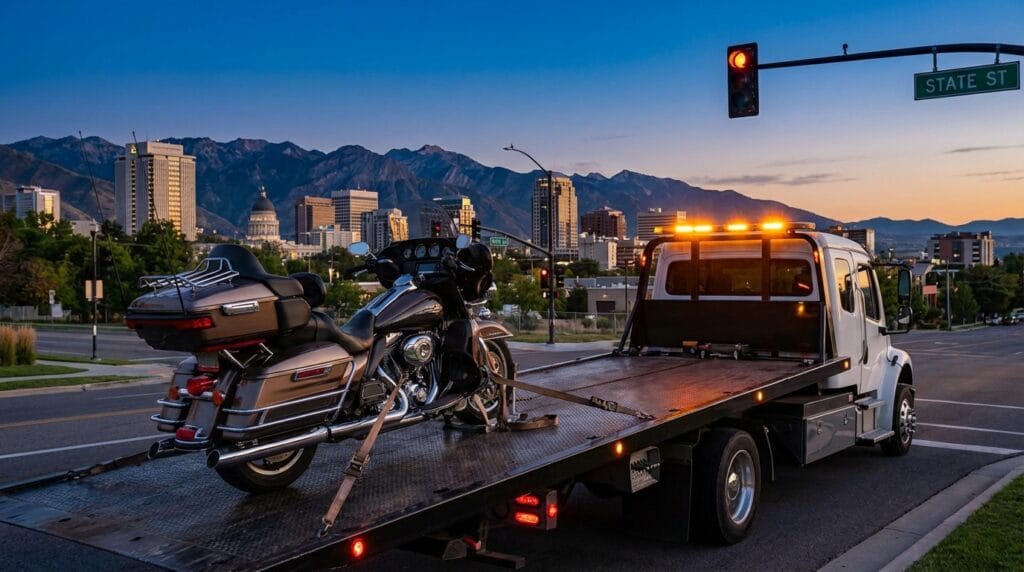
Salt Lake City Motorcycle Towing: Zero-Damage Hauls
Riding the Wasatch Front demands precision, but transporting your bike requires a different kind of engineering to prevent thousands of dollars in frame and suspension damage. We deliver specialized motorcycle towing in Salt Lake City that prioritizes structural integrity and paint preservation over speed, ensuring your ride arrives at the shop or winter storage exactly as it left the curb.
Key Concept: Stabilized Transport vs. “Hook and Go”
In the towing industry, motorcycles are classified as “unstable loads.” Unlike a sedan that sits on four locked wheels, a motorcycle on a flatbed is fighting gravity and physics every mile. Motorcycle towing isn’t just about moving a vehicle; it is about creating a temporary, rigid chassis interface that isolates the bike from road vibration without destroying its own suspension.
For Salt Lake City riders, the stakes are higher. Our geography—steep canyon roads like Big Cottonwood and high-speed, salt-laden winter interstates—means that a standard “strap it down” approach fails. A loose strap in the Avenues might just mean a scratch; a loose strap coming down Parleys Canyon means a total loss. We define our service as Stabilized Transport: using dedicated equipment to lock the bike’s vertical axis, rendering it immobile relative to the tow deck, regardless of the terrain.
Deep Dive: The Physics of Safe Towing
The most common damage we see from DIY or amateur towing isn’t the bike falling off—it’s blown fork seals and bent handlebars from over-torquing.
The Suspension Compression Paradox
You must compress the suspension to keep the straps tight, but compressing it too much creates internal pressure that, when combined with a pothole, blows out the oil seals.
- The Sweet Spot: We aim for 25-40% suspension compression. This maintains tension on the hooks without bottoming out the forks.
- The Risk: If a tower compresses your forks 80-90% “to be safe,” the internal air gap in the fork tube disappears. When the tow truck hits a bump, the hydraulic pressure spikes, rupturing the rubber seals. You arrive with a secure bike, but a $600 repair bill for leaking forks.
Equipment Hierarchy: The Right Tool for the Job
| Feature | Standard Tow Truck | Our Moto-Specific Protocol |
|---|---|---|
| Front Stabilization | Metal hook against handlebars | Soft Loops (Nylon) + Handlebar Cuffs |
| Wheel Security | Pushed against cab wall | Condor/Pingel Wheel Chock (Locks geometry) |
| Tension Method | 10,000lb Ratchet (Overkill) | Cam Buckle Straps (Human-force limited) |
| Rear Security | Often ignored | Lateral Stabilizers (Prevents fishtailing) |
The Winter Factor: Salt Corrosion
December in SLC means sodium chloride and magnesium chloride on the roads.
- The Threat: Towing a bike on an open flatbed on I-15 in winter turns it into a salt sponge. The mist from the truck’s wheels coats the bike’s aluminum engine casing and chain.
- Our Solution: For winter transport, we recommend immediate post-tow rinsing or enclosed transport options. If open transport is the only choice, we position the bike in the “slipstream” shadow of the cab and use protective covers on sensitive electronics.
Actionable Steps: Preparing for the Tow
If you are calling us for a recovery or a scheduled move to winter storage, following these steps ensures a faster, safer load-out.
- Neutral is Non-Negotiable
Ensure the bike is in neutral. Forcing a bike up a flatbed ramp in gear drags the rear tire, flat-spotting it and stressing the transmission.
- Pro Tip: If your battery is dead and you have an electronic shifter (common on newer touring bikes), let dispatch know. We need to bring dollies to lift the rear wheel.
- Disable the Alarm
A motion-sensitive alarm will scream for the entire 20-minute ride to the shop. This doesn’t just annoy the driver; it drains your battery, potentially complicating diagnostics when you arrive at the mechanic.
- Remove the “Wind Sails”
Remove large windshields, saddlebags (if detachable), and helmets strapped to the seat. At highway speeds, a windshield on a backward-facing bike (rare, but sometimes necessary) can snap off. Even facing forward, loose accessories vibrate loose.
- Identify Aftermarket Modifications
Tell the operator about carbon fiber fairings, lowered suspension, or custom exhaust pipes. Standard tie-down points might be obscured or too fragile on a modified bike.
Nuance: The “Soft Strap” & EV Revolution
The Myth of the Handlebar Hook
Riders often think, “It’s metal, it can take it.” Wrong. Steel hooks on steel handlebars gouge the chrome and can crimp control cables (clutch/brake lines) routed along the bar. We use Soft Loops—loops of high-strength nylon that wrap around the triple tree or lower triple clamp. This keeps metal hooks away from your paint and chrome entirely.
Electric Motorcycle Towing (The New Standard)
With the rise of Zero, LiveWire, and other EV bikes in SLC, the rules have changed.
- No Neutral: Some EV bikes don’t have a mechanical neutral gear. If the system is dead, the motor provides resistance. Dragging it generates heat and electricity (regenerative braking) that can fry the inverter.
- Battery Placement: You cannot strap over the battery pack. On many EV bikes, the “tank” is plastic cladding over high-voltage rails. Compressing this area cracks the bodywork. We use tire-capture systems or lower-frame tie-downs exclusively for EVs.
- High Voltage Safety: Our drivers are trained to identify orange high-voltage cabling. We never route a strap near these lines to avoid abrasion and potential arcing [1].
Future Outlook: Smart Towing
The towing industry is moving toward Telematics and Load Monitoring. By late 2026, we expect to see smart chocks that measure the G-force exerted on the bike during transit, providing a digital “health report” of the tow. This transparency will be crucial for high-value vintage bikes and custom choppers, offering proof that the suspension was never over-compressed.
Furthermore, as bike frames move toward cast aluminum and carbon fiber (like the Ducati Superleggera), the margin for error in strapping torque shrinks. The “hand-tighten” feel is being replaced by torque-limiting ratchets that physically cannot exceed a safe pressure threshold.
Conclusion: Don’t Risk the Rig
Your motorcycle is likely your second biggest investment. Trusting it to a generic tow operator who treats it like a broken-down sedan is a gamble you shouldn’t take. We combine local SLC knowledge—navigating icy avenues and steep driveways—with industry-leading motorcycle towing protocols. Whether you need a rescue from the side of I-80 or a scheduled transport to a climate-controlled storage unit, we have the gear to keep your forks sealed and your fairings scratch-free.
Ready for a safe haul? Call our dispatch team immediately at 801-701-1233. Learn more about our equipment and safety standards on our About Us page.