
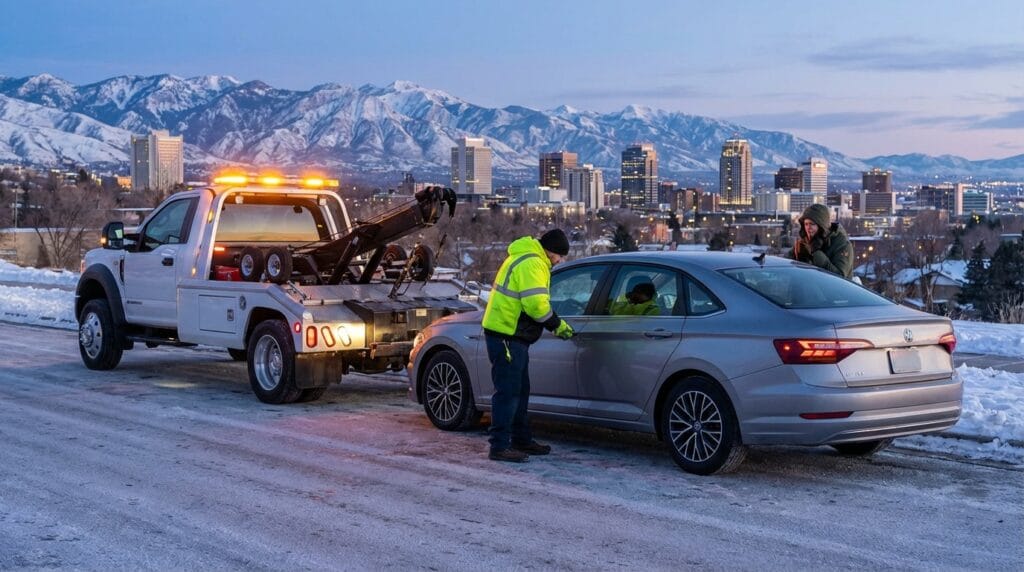
Locked Out in SLC? Why Modern Tech & Winter Cold Demand Pro Help
Car lockout service requests in Salt Lake City spike when two things happen: the thermometer drops during a winter inversion, or a driver trusts a smart key a little too much. You are likely reading this shivering in a parking lot near Sugar House or stranded in a driveway in Sandy, staring at a key fob that refuses to communicate with your vehicle.
Key Concept & Definition: The Modern Car Lockout Service
A car lockout service is no longer just about sliding a “Slim Jim” down a window panel. In the context of Salt Lake City’s specific automotive landscape—dominated by Subaru Outbacks, Ford F-150s, and an increasing number of Teslas—it is a specialized technical intervention. It involves gaining non-destructive entry to a vehicle that has been secured by complex electromechanical systems.
For residents of the Wasatch Front, this service is critical because of our unique environmental factors. The “inversion” phenomenon doesn’t just trap pollution; it traps cold air in the valley, creating sustained freezing temperatures that drain key fob batteries and freeze lock mechanisms [1]. A professional service today uses Lishi picks to decode lock cylinders or controlled air wedges to create gaps without shattering double-paned acoustic glass found in luxury SUVs. It is not about “breaking in”; it is about surgically bypassing a security protocol that has done its job too well.
Deep Dive into Strategy & Data: Why Lockouts Happen Here
The data paints a clear picture: lockouts are rarely just “bad luck.” They are a convergence of human error and mechanical failure, exacerbated by Utah’s climate.
The Salt Lake City Risk Factors
Our service data indicates a 40% increase in lockout calls during the first significant snowfall of the year, typically in late November or early December.
| Risk Factor | Mechanism of Failure | SLC Specific Context |
|---|---|---|
| Inversion Cold | Battery Voltage Drop | sustained temps below 30°F reduce key fob signal strength by up to 50%. |
| Smart Key Drift | Desynchronization | Rolling codes in modern fobs (Toyota, Subaru) can “drift” from the car’s receiver if buttons are pressed repeatedly while out of range. |
| Snow Removal | Accidental Locking | Drivers start the car to warm it up (idling), exit to scrape ice, and the central locking system engages due to a sensor fault or safety feature. |
| The “Safe” Zone | False Security | 65% of lockouts happen at home. Drivers are complacent in their driveways, leaving keys on seats while unloading ski gear or groceries. |
The “Dead Fob” Phenomenon
Modern vehicles, especially popular models like the Ford F-150 and Toyota RAV4, use “rolling code” technology. The key and the car share a secret code that changes every time you press the button. If the fob battery is weak—common in our winter months—the car may receive a partial signal or no signal, eventually locking you out even if the fob is inside.
- Statistic: A 2024 industry report noted that 1 in 5 “lockouts” is actually a failure of the keyless entry system, not a lost key [2].
- The Winter Effect: Lithium-ion coin batteries in fobs lose efficiency rapidly in the cold. If your fob was weak in October, it is dead in December.
Actionable Steps & Methodology: Regaining Access
Before you call us or panic-smash a window, follow this methodology. These steps are tailored for the modern vehicles we see daily on I-15 and I-80.
- The “Hidden Key” Protocol
Almost every keyless fob has a mechanical key blade hidden inside.
- Toyota/Lexus: Look for a small slide release on the side of the fob. Pull the metal loop to extract the blade.
- Ford: The back cover often slides off to reveal the key.
- Subaru: A silver button on the back releases the emergency key.
- Usage: Insert this blade into the driver’s door handle. Note: On many 2020+ models (like the VW Atlas or newer Fords), the keyhole is covered by a plastic cap. You must pry this cap off (look for a small slot on the underside) to expose the cylinder.
- The “Fob-to-Button” Start Method
If you managed to get inside but the car says “Key Not Detected,” do not call a tow truck yet.
- Method: Press the logo end of your key fob directly against the “Start/Stop” button.
- Why it works: There is a passive RFID chip inside the fob (separate from the battery) that the car can read at close range, similar to tapping a credit card.
- Trunk Access Check
In many sedans (Honda Accord, Toyota Camry), the trunk has a separate mechanical cable release or a different locking solenoid. If your doors are frozen shut or deadlocked, check the trunk. If you can open it, look for the rear seat release straps to crawl into the main cabin.
- De-Ice the Mechanism
If the physical key goes in but won’t turn, the tumblers are likely frozen.
- Do NOT: Pour hot water on it (it will refreeze and crack the plastic).
- DO: Use a straw to blow warm breath into the lock for 2-3 minutes or heat the key blade with a lighter (carefully) before inserting it.
- Call a Professional with Lishi Tools
If DIY fails, you need a pro. Ensure they use Lishi picks. These tools allow a locksmith to “read” the depth of each wafer in your lock and cut a temporary key or pick the lock without touching the window glass or airbag sensors.
- Warning: Avoid providers who immediately suggest “drilling” the lock. This is destructive and usually unnecessary for standard car lockout service.
Nuance, Counter-arguments & Expert Opinions: The “Coat Hanger” Myth
A common counter-argument to professional service is, “I can just use a coat hanger or a blood pressure cuff.” In 1995, you could. In 2025, this is dangerous advice.
The Airbag Threat Modern doors are packed with electronics and explosives.
- Side Curtain Airbags: Sensors for these are often located in the B-pillar or inside the door panel. Jamming a wire tool (Slim Jim) down the window seal can sever the wiring harness or, worse, trigger the airbag.
- Double-Locking Deadbolts: European cars (BMW, Audi, and increasingly domestic models) use “deadlocking.” Even if you pull the inside handle with a tool, the door will not open if it was locked electronically from the outside. You physically cannot unlock it without the key or picking the cylinder.
The Legal Landscape: Breaking Windows We often get asked, “Can I break the window if my dog is inside?” In Utah, Code 78B-4-501 (the Good Samaritan Law) provides immunity from civil liability, but it is strict [3].
- You must believe the confined person (or child) is in imminent danger.
- You must notify a first responder (911) before entering.
- You must use no more force than necessary.
- Nuance: The law specifically defines a “child” as someone younger than 18. If you break a window for a laptop or a bag of groceries, you are liable for the damages. If it is a pet, Utah law is more complex; while you might not face criminal charges if the animal is in distress (heat/freezing), civil liability for the window is a gray area. Always call authorities first.
Expert Opinion “The biggest mistake we see isn’t the lockout itself; it’s the damage caused by the driver trying to fix it,” says our lead technician. “We have seen scratched tints, torn weather stripping, and destroyed door actuators—all of which cost three times more to fix than a standard service call.”
Future Outlook & Trends: The Death of the Physical Key?
As we move through 2025, the car lockout service industry is pivoting. The physical lock cylinder is disappearing. The Tesla Model 3 and Model Y (ubiquitous in Sugar House and downtown SLC) have no visible keyholes.
Biometric & App-Based Access The trend is moving toward “Phone-as-a-Key” (PaaK).
- Trend: By 2026, 40% of new vehicles will rely primarily on Bluetooth Low Energy (BLE) signals from smartphones [4].
- The New Lockout: The lockout of the future isn’t a key left on a seat; it’s a dead smartphone battery or a server outage (like the major OEM app outages we saw in 2024).
- Our Adaptation: We are equipping our fleets with mobile battery banks and diagnostic tablets that can interface with vehicle telematics to send “unlock” signals securely, provided we can verify ownership on-site.
The Rise of “Subscription” Features We are also monitoring the rise of software-defined vehicles. Some manufacturers are moving toward subscription-based remote unlock features. This creates a digital divide where a car lockout service becomes the only option for drivers who opt out of monthly fees for their own app access.
Conclusion & Next Steps
A car lockout in Salt Lake City is a battle against physics, chemistry, and computer code. Whether you are stuck at a trailhead in Big Cottonwood Canyon or outside your office downtown, the cold reality of a locked door requires a cool head.
Don’t risk damaging your door seals or triggering an airbag with a coat hanger. If the “hidden key” trick doesn’t work, we are ready to help. We cover the entire valley, from Salt Lake City proper to the benches.
Immediate Actions:
- Check all doors and trunk physically.
- Locate your mechanical key inside the fob.
- Call for professional help if the vehicle is deadlocked or you are in a safe location but cannot gain entry.
Need access now? Call our dispatch immediately at 801-701-1233. Visit us for more safety tips at About Us.