
How to Recover From a Skid on Icy Roads
Key Takeaways
- Immediate Action Required: When skidding, immediately remove your feet from both the accelerator and the brake pedals to allow the wheels to regain traction naturally.
- Steering Technique: Always steer gently in the direction you want the front of the vehicle to go; overcorrecting can cause the car to spin in the opposite direction.
- Braking Protocol: Do not slam on the brakes; if you have ABS, apply steady pressure, but if you lack ABS, use the threshold braking technique to prevent wheel lockup.
- Prevention is Key: Winter tires can reduce braking distance by up to 25% on ice, making them a critical investment for Utah winters.
- Professional Support: If a recovery isn’t possible, staying inside your vehicle and calling for roadside assistance is the safest course of action.
Driving during winter requires specialized knowledge and quick reflexes, especially when navigating the treacherous conditions of icy roads. Understanding how to regain control of your vehicle effectively can be the difference between a safe arrival and a dangerous collision.
What Causes a Car to Skid on Ice?
A skid occurs when the friction between your vehicle’s tires and the road surface is overcome by inertia, causing the tires to lose their grip and the vehicle to slide uncontrollably. This loss of traction is most frequently caused by excessive speed for the conditions, sudden braking, or aggressive steering maneuvers that break the tire’s adhesion to the ice. While modern vehicles are equipped with traction control systems, the fundamental physics of ice—specifically the coefficient of friction, which can drop near zero on black ice—means that technology alone cannot always prevent a slide.
According to the Federal Highway Administration, over 116,000 people are injured in vehicle crashes on snowy, slushy, or icy pavement annually. Understanding the mechanics of a skid is the first step in prevention. There are generally three primary triggers for loss of control:
- Wheel Spin: Acceleration is too aggressive, causing tires to spin faster than the vehicle is moving.
- Wheel Lockup: Braking is too hard, causing tires to stop rotating while the vehicle continues moving due to momentum.
- Cornering Force: Turning too sharply causes the centrifugal force to exceed the tire’s grip on the road.
Recognizing signs your brakes need attention before winter hits can also reduce the risk of wheel lockup. If your braking system is uneven or worn, it becomes significantly harder to modulate pressure on slippery surfaces.
How to Identify the Type of Skid
To recover successfully, you must instantly identify whether you are experiencing a front-wheel skid (understeer) or a rear-wheel skid (oversteer) based on how the steering wheel feels and how the car is rotating. The recovery techniques differ slightly, and misidentifying the sensation can lead to incorrect inputs that worsen the situation.
Front-Wheel Skid (Understeer)
A front-wheel skid happens when the front tires lose traction, causing the vehicle to continue traveling straight even though you are turning the steering wheel. This is common when entering a curve too fast. You will feel the steering wheel become “light” or loose because the tires are no longer gripping the pavement.
Recovery for Understeer:
- Remove your foot from the accelerator.
- Do not hit the brakes.
- Straighten the steering wheel slightly to help the front tires reconnect with the road surface.
- Once grip is restored, gently steer back into the turn.
Rear-Wheel Skid (Oversteer)
A rear-wheel skid, often called fishtailing, occurs when the rear tires lose traction and slide sideways, causing the car to rotate. This feels like the back of the car is trying to overtake the front. This is the most dangerous type of skid because it can easily lead to a 180-degree spin if not corrected immediately.
Recovery for Oversteer:
- Look exactly where you want the car to go (down the road), not at the obstacle you might hit.
- Steer in the direction of the slide (if the rear slides right, turn the wheel right).
- Avoid overcorrecting; as the car straightens out, you must counter-steer gently to prevent snapping back the other way.
Step-by-Step Guide to Recovering From a Skid
The universal rule for skid recovery is to eliminate the forces causing the loss of traction—acceleration and braking—and focus entirely on steering input. As of 2026, advanced driver-assistance systems (ADAS) help mitigate these issues, but manual intervention remains the primary safety mechanism.
1. Do Not Panic
Panic leads to freezing up or slamming on the brakes, both of which guarantee a loss of control. Keep your hands at the 9 and 3 o’clock positions on the wheel to allow for maximum range of motion without crossing your arms.
2. Get Off the Pedals
Remove your feet completely from both the gas and the brake pedal immediately. This is known as “declutching” the tires from the engine’s power and the braking system’s friction. Rolling friction (an unpowered, unbraked wheel) offers more directional control than sliding friction.
3. Steer Into the Skid
Steer the vehicle in the direction you want the front of the car to travel. If your rear end kicks out to the left, turn your steering wheel to the left. This aligns the front wheels with the direction of travel, allowing the rear wheels to fall back in line.
4. Wait for Traction
Do not reapply gas or brakes until you feel the vehicle settle and the tires grip the road again. This may take several seconds, which can feel like an eternity, but patience is critical.
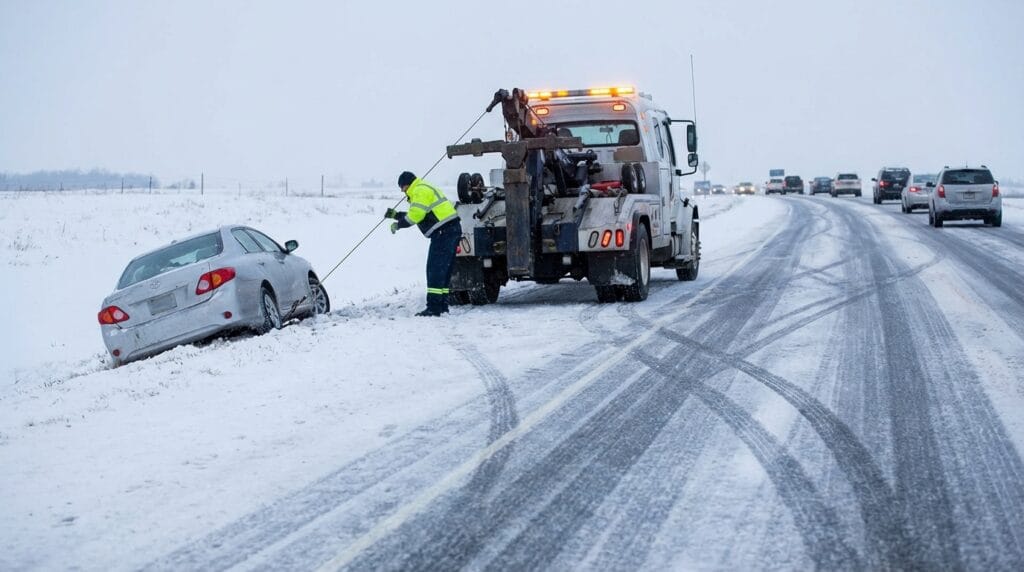
If the vehicle slides off the road despite your best efforts, ensuring you have access to professional accident recovery assistance is vital. Attempting to push a car out of a ditch on an icy highway is extremely dangerous.
Braking Systems: ABS vs. Non-ABS Techniques
Your braking strategy on ice depends entirely on whether your vehicle is equipped with an Anti-lock Braking System (ABS). ABS is designed to prevent wheel lockup automatically, while older vehicles or those with malfunctioning systems require manual modulation.
| Feature | ABS (Anti-lock Braking System) | Non-ABS (Standard Brakes) |
|---|---|---|
| Technique | “Stomp and Steer” | Threshold Braking or Pumping |
| Action | Apply firm, continuous pressure to the brake pedal. | Apply pressure until just before lockup, release slightly, and repeat. |
| Feedback | Pedal will vibrate or pulsate strongly under foot. | No pulsation; driver must feel for tire slip. |
| Steering | You can steer while braking hard. | Steering is impossible if wheels are locked. |
Note: If you have ABS, do not pump the brakes. Pumping ABS brakes confuses the computer and increases stopping distance. Trust the vibration; it means the system is working.
Prevention: How to Prepare for Winter Driving
The most effective way to handle a skid is to prevent it from happening by equipping your vehicle properly and adjusting your driving habits. Stopping distances on ice can be ten times longer than on dry pavement. Preparing your vehicle involves more than just scraping off the windshield; it requires mechanical readiness.
Winter Tires vs. All-Season Tires
Winter tires are made with a specialized rubber compound that remains flexible at temperatures below 45°F (7°C). All-season tires begin to harden and lose plasticity in freezing temps, significantly reducing grip. Industry data suggests that winter tires can stop 30 feet shorter on ice at 30 mph compared to all-season tires.
Battery and Engine Maintenance
Cold weather puts immense strain on your vehicle’s electrical system. A weak battery can fail instantly in sub-zero temperatures, leaving you stranded in dangerous conditions. Before the deep freeze sets in, consider preparing your battery for winter by checking its cold cranking amps (CCA) and age.
The Ice Survival Kit
Every vehicle in Salt Lake City should carry an emergency kit during winter months. This should include:
- Sand, kitty litter, or traction mats for grip.
- A collapsible shovel.
- Jumper cables or a portable jump pack.
- Blankets and hand warmers.
- Flashlight with extra batteries.
When to Call for Professional Help
You should call for professional towing or roadside assistance if your vehicle is stuck in a snowbank, has sustained damage that affects drivability, or if you are in a precarious position on a busy highway. Safety is the priority. If you have spun out and are facing oncoming traffic, or if your engine will not restart, do not exit the vehicle unless you can safely move to a barrier or high ground away from the road.
Salt Lake Towing specializes in difficult winter recoveries. Our drivers are trained to extract vehicles without causing further damage to the suspension or bodywork. We operate 24/7 because we know that ice doesn’t keep business hours. If you are stranded, you can reach us immediately at 801-701-1233.
Frequently Asked Questions
What is the first thing I should do if I start to skid?
The very first thing you must do is take your feet off both the accelerator and the brake pedals. This neutralizes the forces acting on the wheels and allows them to regain traction naturally.
Should I pump my brakes if I hit black ice?
If your car has ABS (Anti-lock Braking System), do NOT pump the brakes; apply steady, firm pressure. If your car does not have ABS, you should gently pump the brakes to prevent the wheels from locking up.
What is black ice and why is it so dangerous?
Black ice is a thin, transparent layer of ice that forms on the road surface, blending in with the pavement and making it nearly invisible. It is dangerous because it offers almost zero traction and often catches drivers by surprise.
Does 4-wheel drive (4WD) help stop on ice?
No, 4WD helps you accelerate and get moving in snow, but it offers no advantage when braking on ice. All vehicles have four-wheel brakes, and stopping distance is determined by tire grip, not the drivetrain.
How much should I slow down on icy roads?
You should reduce your speed by at least 50% on packed snow and even more on ice. If the speed limit is 60 mph, you should not be traveling faster than 30 mph in icy conditions.
What is the difference between understeer and oversteer?
Understeer is when the front wheels lose grip and the car plows straight despite turning the wheel. Oversteer is when the rear wheels lose grip and the back of the car slides out sideways.
Conclusion
Recovering from a skid on icy roads is a skill that combines calmness, quick thinking, and the right technique. By slowing down, investing in winter tires, and knowing how to steer into a slide, you can navigate Salt Lake City’s winter roads with confidence. If you find yourself in a situation you can’t handle or need immediate roadside assistance, Salt Lake Towing is here to help you get back on the road safely.