
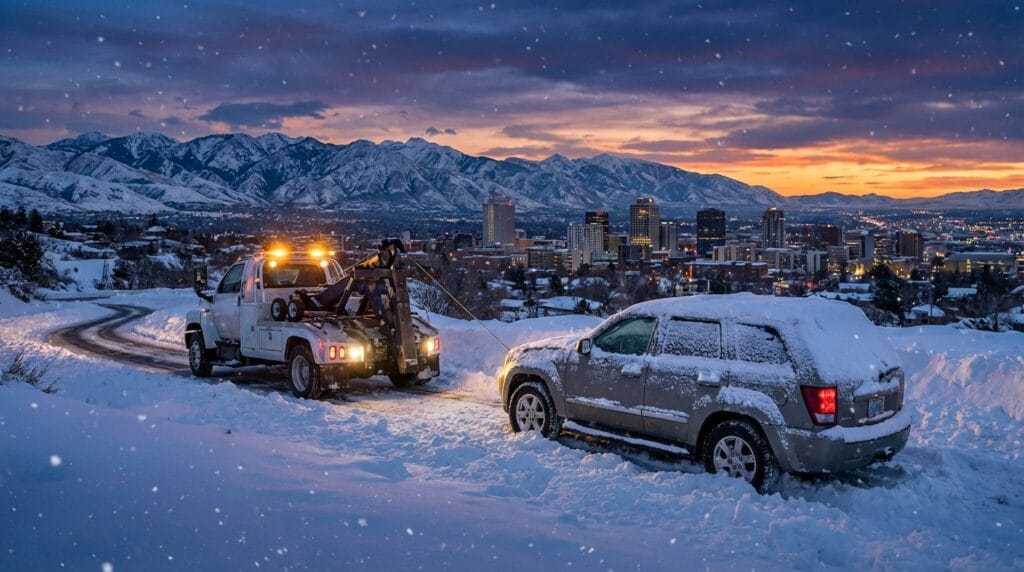
Winch Out Service Salt Lake: Stuck in Snow?
When your vehicle slides off an icy embankment in Parleys Canyon, you don’t just need a tow; you need a winch out service capable of battling gravity and friction simultaneously. We specialize in retrieving vehicles that have lost the battle with Utah’s severe winter terrain, ensuring your car returns to the pavement without catastrophic frame damage.
Key Concept: Defining Winch Out Recovery in the Wasatch
A winch out is distinct from a standard tow. Standard towing assumes the vehicle is accessible and on a relatively flat, paved surface. A winch out is a recovery operation required when a vehicle is “stuck”—immobilized by mud, snow, ice, or uneven terrain—and cannot move under its own power. In the context of Salt Lake City, this most often occurs when drivers slide into snowy berms, high-center on unplowed drifts in the Avenues, or slip off steep driveways in Cottonwood Heights.
The primary mechanism involves a motorized drum and a high-tensile steel cable or synthetic rope. This system allows us to apply a controlled, linear force to your vehicle from a stable anchor point. Unlike a “yank” from a passing truck, which applies dynamic shock loads that can shatter driveline components, our winch out service applies static tension. This allows for precise manipulation of the vehicle, inching it back to solid ground while mitigating the risk of rolling or sliding further into a ditch.
Recovery Strategy & Industry Data
Successful recovery is a math problem, not a brute force contest. We calculate the “Total Resistance” (TR) before hooking up a single cable. If these calculations are ignored, cables snap, anchor points fail, and vehicles are damaged.
The Physics of Being Stuck Three main forces work against your vehicle when it is stuck in Utah snow or mud:
- Rolling Resistance: The force required to drag the vehicle over the surface.
- Gradient Resistance: The weight of the vehicle acting against the slope (gravity).
- Damage Resistance: Forces caused by broken parts dragging (e.g., a twisted wheel).
The most critical factor we assess is “Mire Resistance.” This defines how deeply the vehicle is buried.
| Mire Level | Depth Description | Est. Pull Force Required (% of Vehicle Weight) |
|---|---|---|
| Wheel Depth | Tires are submerged to the rim. | 100% of Gross Vehicle Weight (GVW) |
| Fender Depth | Mud/Snow covers the wheel arches. | 200% of GVW |
| Cab Depth | Door handles or windows are submerged. | 300% of GVW |
The “Suction” Multiplier In the sticky clay-mud found near the Great Salt Lake shoreline or the wet, heavy “Sierra Cement” snow common in late January, suction creates a vacuum effect. This can increase the required pull force by an additional 25-50%. A 5,000-lb SUV buried to the frame isn’t just a 5,000-lb load; it effectively weighs 15,000 lbs in terms of resistance [1]. Standard pickup trucks attempting a DIY recovery often fail here because they lack the weight and traction to overcome this multiplied resistance.
Mechanical Advantage Tactics We utilize snatch blocks (heavy-duty pulleys) to multiply the pulling power of our winches. A single line pull exerts the winch’s rated capacity. By looping the line through a snatch block attached to the casualty vehicle and back to our truck, we create a 2:1 mechanical advantage. This doubles the pulling force while halving the line speed, giving us granular control over the extraction. This technique is vital for recovering heavy work trucks or EVs, which are significantly heavier than gas counterparts due to battery packs.
Actionable Steps & Methodology
If you find yourself sliding off I-15 or stuck in a snowy trailhead lot, your immediate actions dictate the safety of the recovery.
- Cease Acceleration Immediately
The instinct is to floor the gas. This is the worst response. Spinning tires creates heat, melting the snow into ice, which forms a frictionless bowl under your wheels. In mud, it digs the vehicle deeper until the frame rests on the ground (high-centered). Once high-centered, your wheels have zero traction, and self-recovery is impossible.
- Assess the “High Side”
Identify which side of the vehicle is higher. If you are on a slope, gravity wants to pull the vehicle downhill. Never exit the vehicle on the downhill side. If the vehicle slides, you could be pinned. Stay in the vehicle if it is safe, or exit to the high side/up-slope.
- Clear the Tailpipe
If you are idling the engine to stay warm while waiting for us, ensure the exhaust pipe is not buried in snow. A blocked exhaust forces carbon monoxide back into the cabin, which can be fatal within minutes [2].
- Locate Your Recovery Eyelet
Modern vehicles often have a removable plastic square on the front or rear bumper. Behind this is a threaded hole for a “tow eye” (usually found with your spare tire jack kit). Having this ready saves time. Do not attach straps to suspension control arms, drive shafts, or bumpers; these components will rip off under winch tension.
- Call for Professional Extraction
Contact our dispatch. Be ready to describe:
- Surface: Is it pavement, mud, snow, or ice?
- Distance: How far is the vehicle from solid ground (the “winch reach”)?
- Incline: Is the vehicle nose-up, nose-down, or sideways on a hill?
Once we arrive, we stabilize our wrecker using wheel chocks and hydraulic spades that dig into the pavement or frozen earth. This anchors our truck so the winch pulls your car out, rather than pulling our truck in.
Nuance, Counter-arguments & Expert Opinions
The “Buddy with a Strap” Fallacy A common counter-argument is, “I’ll just have my friend pull me out with his pickup.” This is dangerous for two reasons: hardware and physics. Most consumer-grade “tow straps” sold at auto parts stores are not rated for recovery. They often have metal hooks that, if the strap snaps, become lethal projectiles flying at 200 mph. Furthermore, a pickup truck relies on traction to pull. On ice, the pulling truck often loses traction before moving the stuck vehicle. To compensate, the driver usually backs up and takes a running start (a “dynamic yank”). This shock load spikes force instantly. If your vehicle is stuck with 10,000 lbs of resistance, a dynamic yank can exert 40,000 lbs of force in a millisecond. This shears bolts, bends frames, and snaps axles. Our hydraulic winches apply steady pressure, eliminating shock loads.
The AWD/4WD Myth “I have 4-Wheel Drive, I shouldn’t get stuck.” All-Wheel Drive helps you go, but it does not help you stop or float. In deep snow, ground clearance matters more than drive wheels. If your vehicle has 8 inches of clearance and the snow is 12 inches deep, your undercarriage acts as a plow until the snow compacts into a solid block, lifting your wheels off the ground. At that point, 4WD is useless because the tires aren’t touching anything with friction.
Expert Insight on Electric Vehicles The rise of EVs in Salt Lake City presents new recovery challenges. EVs are 20-30% heavier than combustion vehicles. A stuck Tesla Model X or Rivian R1T requires significantly heavier rigging than a Ford Explorer. Additionally, EVs have flat underbellies housing batteries. Improper winching angles can drag this battery pack over rocks or ice chunks, risking puncture and fire. We use specific low-angle bridles to lift the nose slightly while pulling, protecting the high-voltage components [3].
Future Outlook & Trends
Synthetic Rope Standardization The industry is shifting from steel cable to synthetic rope. Synthetic lines are lighter, float in water/mud, and do not store as much kinetic energy as steel. If a steel cable snaps, the whiplash can slice through a car door. Synthetic rope drops dead to the ground. We are progressively upgrading our fleet to synthetic lines to maximize safety for bystanders and client vehicles.
GPS-Enabled Recovery Anchors New technology is emerging for extreme off-road recovery involving “smart anchors” that bury themselves into the ground and report load data to an app. While currently niche, this tech may soon allow recovery in salt flats or areas where no trees or other vehicles exist to serve as anchor points.
The Impact of Climate Variability Salt Lake’s winters are becoming more erratic—freeze-thaw cycles create layers of ice under fresh powder. This “sandwich” terrain is treacherous. We are seeing an increase in “slide-offs” where a vehicle is stationary but slowly slides sideways off a crowned road due to sub-surface ice melting. Recovery in these conditions requires lateral winching (pulling from the side) rather than just pulling forward or backward.
Getting Back on Solid Ground
Winter in the Rockies is unforgiving. One moment of distraction or a patch of black ice can leave your vehicle stranded in a snowbank, miles from a warm hearth. A winch out is not a DIY project; it is a calculated industrial operation requiring understanding of load vectors, resistance ratios, and equipment ratings.
Don’t risk tearing your bumper off with a cheap strap or succumbing to carbon monoxide while waiting for a friend who might get stuck themselves. We have the heavy-duty wreckers, the snatch blocks, and the expertise to extract you safely.
If you are wheels-deep in the white stuff, stay warm and let us handle the heavy lifting.
Stuck? Call the recovery experts. 801-701-1233 Request Assistance Online
Sources
- Department of the Army. (2000). FM 4-30.31 Recovery and Battle Damage Assessment and Repair. Washington, DC: Headquarters Department of the Army.
- Centers for Disease Control and Prevention. (2024). Carbon Monoxide Poisoning: Winter Storm Risks.
- National Fire Protection Association (NFPA). (2025). Emergency Response Guides for Electric Vehicles.